The Aesthetic of Despair


The Aesthetic of Despair


Is despair an excellence or a defect? Purely dialectically, it is both. The possibility of this sickness is man’s superiority over the animal, for it indicates infinite sublimity that he is spirit. Consequently, to be able to despair is an infinite advantage, and yet to be in despair is not only the worst misfortune and misery—no, it is ruination.

Soren Kierkegaard, The Sickness Unto Death


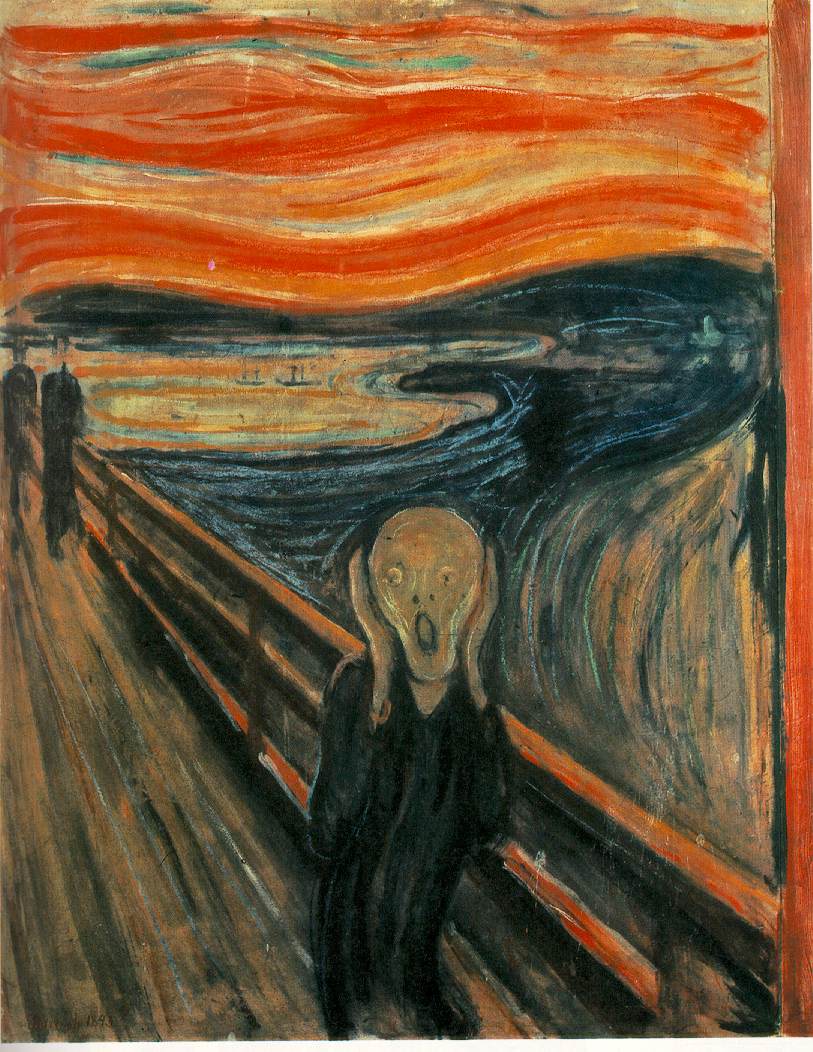
Despair has a beauty all it own. Most terrible things do. But for some reason, most people don’t think much about despair’s aesthetic side. Yet despair’s awful beauty can be seen in the arts that it has inspired. The architecture that springs from despair is awesome in the full sense of the word. Paintings that have been inspired by despair can hardly be called pretty, and yet your eye is drawn to them. You cannot look away. Books inspired by despair are awful to read and yet still such books are ranked as some of the best books that have ever been produced. In all of these works of art, despair is the source of their great artistic power. It is what drove the artists and it is what gives their work such power to stir our own feelings. The aesthetic power of despair is so great that for many people it is the only source of real beauty that they know.
Goths are a fine example of a subculture where despair is the guiding aesthetic principle. But the Goths raise an interesting question: if despair truly has a beauty, how come so many people fail to see a pleasing aesthetic in Goth culture? Few people besides the Goths themselves see any beauty in people who paint themselves in black and white. They can not comprehend why people would exchange their flesh for metal. It horrifies them that the Goths cut themselves as a form of emotional release. The cumulative horror of the Goth subculture bewilders outsiders and leaves them wondering what could possible cause a human being to want to be part of such a subculture. Where is the beauty in the Goth aesthetic?

In order to properly explore such a question, we must first make a distinction between what is pretty and what is beautiful. A model walking down a runway is pretty; a disabled child overcoming great obstacles to take a few steps is beautiful. To be truly beautiful, to truly move someone, something must have meaning. To be pretty, something must only please the senses. Something can please the senses without having any meaning, but at the same time, something can be displeasing to the senses and yet still be beautiful. This distinction between beauty and prettiness is what divides high and low art. Low art is what is designed solely to please the senses; wildly popular for time, then it fades away. High art is what aspires to have meaning though it is often not pleasing to the senses. But to those for whom it has meaning it is far more beautiful than low art and they preserve it for the ages.

Going back to the Goths, we can now rephrase our question; what is it about the Gothic subculture that has meaning for some people? The answer is all too easy to see if you look at the wider culture that the Gothic subculture springs from. After all, the pop culture’s aesthetic is based on vanity, fakery, and delusion; whatever word you think best describes the pop culture’s aesthetic, the inescapable truth is that the aesthetic of pop culture is by design meaningless. In part you can see this in the aesthetic of personal looks, which is all about faking things you don’t have and pretending to be things that you are not. But perhaps the archetype of the meaninglessness of pop culture is the action movie. Standard parts of this movie are portrayals of sacrificial love and battling evil. Yet you know that artists and writers of the movies would deny that the word “evil” has any real meaning or that there is any meaningful distinction between love and lust. Such a movie is meant only to distract us from the real world, where right and wrong is ambiguous, and there is no love that can be relied upon. If you want to see a movie that has real meaning, one that has truth in it, it is going to be one full of despair. But one does not need to rely only on movies to prove this point; the same can be said of most of today’s popular culture. The only real thing in this culture’s art is the despair; everything else is meaningless by design.

What is fake cannot have meaning. What is without meaning cannot have beauty. Is it any wonder that the Goths fail to see any beauty in the aesthetic of a culture that pressures them to try to look either older than they are or younger than they are so that they might find someone who will offer them fake love? By embracing the look of death the Goths are embracing the one thing that they know to be real. Their look is testifying to each other and to the world that they are not striving after any fake things, no matter how pretty they might seem. Even when they are cutting themselves the Goths are only being more real than the rest of their modern compatriots. After all, as long as cutting oneself is done in moderation it is no more harmful than drugs, alcohol, food, or the many other ways that people use to deal with their despair. Cutting oneself is just a more honest way of destroying oneself in despair than those who mask the fact that they are destroying themselves with temporary pleasure.

But why embrace despair as a governing aesthetic even if nothing else has meaning? Why not take the pleasure that can be found in the merely pretty things? Even if prettiness is meaningless, surely it is better then dwelling on the despair that all humans feel at some time or another. But to a man who is thirsting for meaning, the merely pretty things are like salt water to a man who is dying for lack of water. Pretty things only serve to increase the torment of such a man. The prettiness merely serves to sharpen the hunger for the beautiful. Better, if you hunger for meaning, to wallow in the real despair than to be tormented by the fake pretty. As Dylan Thomas said in the last stanza of his poem Do Not Go Gentle Into That Good Night……

And you, my father, there on the sad height,
Curse, bless me now with your fierce tears, I pray.
Do not go gentle into that good night.
Rage, rage against the dying of the light.

This is the summation of the Goth aesthetic. This is the summation of anyone whose aesthetic sense recognizes only despair as having any meaning: the desire to be blessed with real tears rather than a pretty facade put over something horrible. Even if the blessing of the real tears serves only to highlight the curse that they live under, it is still better than putting a fake smile on the face of death.

The idea that real face of death is better than death with a fake smile on its face is not an argument that can be made with logic or un-made with logic. It is purely an aesthetic choice. The fact that such a choice must be made on aesthetic grounds reveals how critical our perception of beauty is not only to our judgment of art, but how we seek to live our lives. This is why good art is so meaningful to humans.

Our sense of aesthetics is so important to how we live our lives that it can sometimes even trump our sense of what we need to do to survive and prosper. There have been countless starving artists throughout history who demonstrate on the most basic level that this is true. But the idea that there is a fundamental conflict between people’s sense of aesthetics and their sense of what is necessary to survive and prosper in life has broader application than the lives of a few talented people willing to suffer almost anything for their art.

It is around the conflict of the pragmatic versus that which is aesthetically pleasing that Aldous Huxley’s book The Brave New World turns. As every reasonably well-read person knows, the Brave New World is all about a perfect world where everyone is pretty, no one is unhappy, and everyone has as much sensual pleasure as they could possibly want. But we are meant to understand that this world is a horrible world. We are meant to be horrified by the teaching of children from an early age to engage in meaningless sexual activity. We are meant to understand that such a world has sacrificed everything of real meaning. We are meant to understand that in such a world there is no faith, hope, or love. And if we should be so dense as to fail to pick up on any of this, characters are introduced as the book progress to pound these themes into our head. The culmination of the book is a debate between the Savage, who is horrified by the Brave New World, and the scientifically minded Controller.

The Savage’s argument against the utopia was based on aesthetics. The root of his argument was that there was no longer anything that could be considered truly beautiful in the Brave New World because nothing was meaningful anymore. Shakespeare was the weapon that the Savage relied upon to make his case. Using the bard’s eloquent language, the Savage sought to invoke all the beautiful things that had been destroyed to make the Brave New World. He sought to make the Controller understand that the price that had been paid for the Brave New World was far too high. The Savage argued that, far from being a utopia, the Brave New World was in fact a type of hell. The Savage felt that the absence of beauty made life not worth living.

Controller’s counter-argument was based on the pragmatic. The Controller demonstrated that all the things the Savage accused him of destroying: chastity, heroism, love–were all sources of unhappiness and grief. What good is a mother’s love for her child, if all that it accomplishes in the end is to give her uncontrollable grief at the death of her child? What good is chastity, if it must be accompanied by unsatisfied hungering and jealous rages? To be sure, the Controller’s choice eliminates all that is truly beautiful, but it also eliminates all that is truly ugly as well. For the Controller this is a price worth paying, because to him the highest demand that humans have is the pragmatic. The desire for shelter, health, pleasure, and other basic animal wants are what sensible humans strive to take care of above all else.

If the Savage’s argument against the Brave New World can be boiled down to a powerful and moving accusation that nothing beautiful remained in the Brave New World, the Controller’s counter-argument can be boiled down to an equally powerful and devastating question: what good is the search for meaning if, in the end, it must always go unsatisfied? To paraphrase the Controller, it would be one thing if you could show that the search for meaning (and thus beauty) would ultimately end in happiness. Than maybe you could argue that the search for meaning might be worth the pain. But all of human nature and human history serves to show that the human search for meaning is one that is doomed to futility and is one of the primary causes of human pain. To the Controller, the Savage is trying to stop human progress, for human progress is all about eliminating unpleasantness and maximizing human pleasure. As the Controller demonstrates, the hunger and search for meaning must be gotten rid of in order to achieve those goals. And if you get rid of meaning, you must also get rid of beauty.

It is far better to read the back-and-forth between the Savage and the Controller than any dry recapitulation of the debate. Most educated people are already familiar with Huxley’s book anyway. But often, those same educated people do not seem to realize that the Savage lost the argument. They might remember that the Controller reduced the Savage in the latter part of the debate to someone who was demanding the right to be unhappy. But this demand people have often chosen to spin as a heroic demand for freedom instead of the admission of defeat that it is. They fail to see that the reason that the Controller is so willing to grant the Savage his right to be unhappy, is that he was confident that the Savage will use this right to prove the Controller correct in the most final way possible. In this the Controller is correct, for the last chapter of the book describes how the Savage proceeds to demonstrate the futility of his hope.

In the book, the aftermath of the debate has the Savage retreating to a secluded place where he attempts to drive out of himself all of the animal desires that made him want to go back to the Brave New World…made him want to go back and look for the woman that he loved (or thought that he could love, hoped that he loved, hoped that he had a love in him that was more than just lust) that he knew would never love him. The Savage wanted to prove that his view of what was beautiful could sustain him. He wanted to prove that he could overcome himself and make himself meaningful. To that end, he sought to punish his body by denying it any kind of easy comfort. From there he went on to self-flagellating, and from there to suicide. The Savage’s end serves as a type of vindication of the Controller’s argument that the search for meaning is pointless, even as the aesthetic sense that rules the book makes the Savage seem beautiful even in his despair.

In the terms of this essay, Huxley has the Savage reject the meaningless prettiness of the Brave New World, only to have him embrace the aesthetic of the Goth. For the Savage, the search for meaning ended up being meaningless. The only real things that the Savage could grasp were pain and death. What made the Savage Gothic is that even as despair was overwhelming him he still preferred the despair to the empty prettiness of the Brave New World. Our sense of aesthetics, not our sense of what is smart, is what leads us to sympathize with the Savage. What Huxley did in the Brave New World was to cause people to make a judgment on what type of society is right for man based on our aesthetic sense, not on what is practical. What is more, he brings us to a point where we are willing to say that a life that is based on (and destroyed by) despair is more beautiful than life based on a permanent high of meaningless pleasure. Huxley brings us to the place were we can see beauty in an aesthetic of despair.

It is this part of the book that many people have problems with. They cannot help but be sympathetic to the Savage even as he kills himself. In fact they are so sympathetic that they are often angry that Huxley did not give the Savage a better choice. They are not content with the fact the Savage’s despair makes him more beautiful than the Controller. They want Huxley to make it so that the Savage is proved right logically as well. They want the accusation of the Controller, that the search for meaning itself is meaningless, proved wrong.

It is not only some readers who don’t like the fact that the Controller is vindicated. Aldous Huxley himself was not happy with the way he ended the Brave New World. He later said that if he could write it all over again, he would have given the Savage a saner choice. But I don’t really think that Aldous Huxley could have truly given his book any different of an ending and still been true to his own vision. Huxley had the Savage commit suicide because Huxley could find no hope for the Savage. He could find no hope for Savage because he could not find fulfillment for the hunger that the Savage had. And hunger without fulfillment is always destructive in the end. Thus, for Huxley to change the ending of the Brave New World, he would have had to give the Savage a fake hope. That would have destroyed the beauty of the book, for what is fake cannot be meaningful.

For the rest of his life, Huxley looked for an answer that would allow him to refute the Controller logically as well as aesthetically. He was so desperate to find an answer that he turned to LSD and other drugs, even though he knew them to be very dangerous. It was his own way of destroying himself in an effort to defeat the Brave New World. But Huxley was unable to find a saner choice for himself, much less for his imaginary creation the Savage. Just as the Savage died in a desperate attempt to escape all that was in himself that made the Brave New World so deadly, so too did Huxley take LSD one last time in a desperate attempt to transcend his own limitations and find a way to refute the Controller.

It is the sheer meaninglessness of such despair that causes some people to take the Controller’s argument and run with it. They would try to deny that even despair has any meaning. They would say that the despair of the Goths can be fixed with therapy or pills that correct the bio-chemical imbalances in their brains. They seem to feel that despair is a temporary aberration in the human condition caused by a mixture of genetic and environmental factors. They would argue that unless you correct these problems, it is impossible for anyone to find meaning in anything. For them, meaning can be reduced to the correct bio-chemical mix. With the correct bio-chemical balance in our brains, meaning can be found in everything. But such belief rests on two very dubious pillars. First, that you can equate depression with despair. The second is that you can have meaning without having despair.

To confuse depression with despair is like confusing pain with damage to your body. You can treat pain. You can even do away with pain, but then you would have a condition like leprosy. Any medical student knows that pain is a fundamentally good thing that alerts us to problems. The fact that pain sometimes needs to be treated does not mean that we want to do away with it. The same thing could be said about depression. When we are depressed we feel that things lack meaning or worth. When we despair of something, we intellectually understand that something is without meaning. That intellectual understanding does not necessarily have to coincide with depression, any more than someone who has just broken their back needs to feel pain to know that there is something seriously wrong. But depression drives us toward things that have meaning, just as pain drives us to avoid things that are dangers to us, or hunger drives us to eat. The fact that we can intellectually understand that we need to eat, or that some things are dangerous to us, does not do away with the fact that it would be unwise for us to take away from our bodies the ability to feel hunger or to be depressed. That fact that we can suppress our desire for meaning does not mean that it is wise to do so, even if the hunger for meaning can make our lives very unpleasant. Take the proverbial man who, at the end of his life, wishes that he had not spent so much time at the office. Was the fact that he managed to keep himself so busy that he did not have time to be “depressed” and consider the meaning of what he was doing, really of benefit to him in long run?

The idea that depression is a necessary part of human need for meaning is counter-intuitive to anyone who has ever had a serious problem with depression. Serious depression is often characterized as a state of mind where one cannot find meaning in anything. Even things that once gave you happiness no longer have meaning for you. But such a feeling is logically defensible. To treat a logically defensible feeling as a medical problem needing a cure is as foolish as thinking that feeling pain when touching hot things is a deficiency in the human body. This is where psychologists and other mental health professionals really start to error. If they can see a bio-chemical reason for something, they think that they can treat the problem by treating that bio-chemical reason. But this ignores the fact that bio-chemical things can be (are?) indicative of something. Pain, for example, can be reduced to a bio-chemical reason. Because doctors understand that, we have pain killers. But doctors also understand that the bio-chemical reaction happens for a reason. That pain is pointing to a truth, as it were, that doctors know that they need to understand if they are to do the patient any real good. But if someone comes in and says to a doctor “Everything is meaningless,” the doctor will prescribe Prozac. That doctor will not stop to think if the statement that everything is meaningless is in fact true.

Therapists often fault doctors for relying too much on medication, and not enough on treating the underlying problem. But the approach of therapists is often no better. When confronted by a mother whose child has just been run over by a drunk driver, they recognize a cause for the depression that the mother is feeling. But they tend to take the same track as the doctors that they look down on. They look at this tragedy’s effect on the mother primarily as something that has damaged her by giving her negative emotions. The way they seek to “fix” her is to get her to “release” her emotions. They want her to know that her emotions are normal and to encourage her to talk about them, so that she does not hold onto them and lock herself in her own emotional prison. They want to teach her strategies for dealing with her emotions so that the she can lessen the strength of her emotions and lead a “normal” life. It all sounds so nice, but in realty they would probably do just as well to give her Prozac and shove her out the door.

Her problem is not that her feelings are damaged. Her problem is that her child who once had meaning for her has been turned into a corpse that has no meaning. Not only that, but it happened for a reason that has no meaning that she can discern. Such a tragedy is enough to make you question the meaning of all of life. You don’t need to feel her emotions to understand this. You could write out a logical argument based on her tragedy that life was meaningless, without ever feeling her emotions. To treat the emotions in her that lead her to seek meaning as damage that needs to be dealt with, is ultimately harmful. She does not need to “deal” with her emotions, she needs to find meaning. The reason that therapy tends to do more harm than good is that by focusing so much on dealing with a person’s emotions it gets in the way of the person’s ability to find a solution for the hunger embodied by those emotions.

As Huxley pointed out in the Brave New World, the easiest way to make sure the woman who has lost her child does not feel despair is to make her child meaningless to her. If her child was meaningless to her, she would be indifferent to whether her child died or not. It was for this reason that “mother” was a dirty word in the Brave New World. You cannot have mothers having meaningful relationships with their children without those relationships being a source of despair. The same could be said of anything that people find true beauty in. As Gerard Manley Hopkins wrote in his poem Spring and Fall: To a Young Child..

MARGARET, are you grieving
Over Goldengrove unleaving?
Leaves, like the things of man, you
With your fresh thoughts care for, can you?
Ah! as the heart grows older
It will come to such sights colder
By and by, nor spare a sigh
Though worlds of wanwood leafmeal lie.
And yet you will weep and know why.
Now no matter, child, the name:
Sorrow’s springs are the same.
Nor mouth had, no nor mind, expressed
What heart heard of, ghost guessed:
It is the blight man was born for,
It is Margaret you mourn for.

We come to “such sights colder” because they lose meaning for us. We no longer perceive those sights as being beautiful; rather, we see them as being merely pretty. Is it worth no longer being able to see the beauty so that we are protected from the grief? That is an aesthetic choice, one that is immune to the demands of logic. Yet, I am afraid, logic does tell us that in the end we will weep. We can keep our lives so full that we do not even have time to think, much less be depressed. We can take pills to make our hearts cold so that we no longer feel the pain. But like a man who has leprosy we can not escape what happens to us. When we look at ourselves in the mirror we see that we are as ugly as hell. Our aesthetic choice is not really between grieving and not grieving, but between going into the night with our eyes open or our eyes shut

Surely we are getting too metaphysical here. Surely we are glorifying despair, and its attendant manifestation depression, just a little bit too much. What about the fact that some people are more prone to depression than others? Does that not indicate that the problem with depression is more than just people’s hungering for meaning? But we would not say that because some people have more artistic talent then others, that artistic talent is therefore a flaw, would we?

Of course not. We all accept that artistic talent is a gift. But most often it is a gift that is made possible because they are prone to depression. It is common knowledge that the more creative a person is, the more likely they are to struggle with depression. What is not often acknowledged is that the depression is what makes much of the creativity possible. Just as hunger is necessary to appreciate the food of even the best of chefs, so too is the hunger for meaning necessary for the appreciation of true beauty. Just as hunger makes the most determined hunter, so too are those who hunger for meaning the best at finding it. This is why despair is so often bound up in the higher arts. The hunger is necessary if we are ever to find the beauty. And to find that beauty, the artists must of necessity be someone who hungers after meaning. But just because they hunger for it does not mean that they find it.

That brings us back to the Goths. Hunger may be real, but it is also as destructive in its own way as leprosy. If your aesthetic is based on always being hungry and never getting to eat, it is going to self destruct. Some people have an aesthetic sense that causes them to prefer to look at starving people rather then see the disfigurement of leprosy, but I don’t think either choice really fulfills people’s aesthetic longings. We may be horrified by the Controller’s choice, but we have a sneaking sympathy for his argument. Despair without the hope that meaning even exists (never mind if meaning is attainable or not), is as meaningless as a black canvas. The Goths may disavow the fake, but they can hardly be said to have found something that is real when the only real thing that they acknowledge is the ending of all things. At least the Savage was trying to find meaning even as he was killing himself; the Goths seem to have given up even looking for meaning outside of the truth of death.

Still, as horrible as I find the Goths to be, and even though I understand the logic that leads people to the Controller’s point of view, I still prefer the aesthetic of the Goths to the aesthetic of those who hold with the Controller. Or should I say, I find the Goths less horrifying than the alternative that modern rationality so often presents. I freely admit, it is purely an aesthetic choice on my part. I can at least identify with and sympathize with the pain of the Goths. I can at least share their horror of what is fake. But those who live by the argument of the Controller, they truly horrify me. They would go into that good night so drunk on pleasure that they can no longer tell the difference between what is beautiful and what is ugly. They would destroy man’s aesthetic sense, which is to say they would destroy man. They would….

But to rave on and on about how abhorrent I find the aesthetic of the Controller is meaningless. The Goths are a real subgroup in today’s society; the Controller is a fictional character. To set up the Controller as comparison to Goths is to seemingly set up a straw man in comparison to what is real. Who really believes what the Controller in the Brave New World believed? Who really expresses the aesthetic of the Controller in the real world? To answer that question, all we have to do is look at the contemporary art world.

Any discussion of the contemporary art world needs to start with Andy Warhol. He is one of the most influential founders of an aesthetic sensibility commonly referred to as contemporary art (it is sometimes called post-modern art). It is in Warhol that the “revolutionary” aesthetic of contemporary art was first fully expressed. In fact, the art critic and philosopher Arthur Danto claimed that Andy Warhol’s work “Brillo Boxes” marked the ending of art history. I would rephrase that to say that Warhol marked the start of a direct assault on art itself. More particularly, it marked an assault on the idea that our aesthetic hunger for beauty is in anyway meaningful. Warhol’s work is all about the celebrations of man’s animal needs and desires while at the same time mocking the very idea of meaning. All I see in Warhol’s work is an aesthetic expression of the Controller’s argument.

In fact, Warhol’s aesthetic is so much in line with Aldous Huxley’s fictional Controller that if you made Warhol up you would be accused of plagiarism. The similarities start with the superficial, such as Warhol’s worship of Ford, Warhol’s obsession with the Freudian way that advertisers created desire, and the way that Warhol industrialized of the creation of “art”. But what really ties Warhol to the Controller is the message that is implicit in Warhol’s body of work. Over and over throughout his career, Warhol took things that were traditionally considered mundane or base and he celebrated them. He celebrated them because they were mundane and base, not because he thought he saw some beauty in them that people were overlooking. He celebrated them as a direct rebuke to those artists who chose to believe that if you look hard enough, you can find beauty in anything. Through his work, Warhol sought to show that if you look hard enough everything is meaningless. The only thing you can get out of life is a kind of ephemeral pleasure. And even that pleasure, Warhol sought to show, is a product of your conditioning.

To advance his aesthetic vision (if a vision that mocks the very notion of beauty can be called an aesthetic) Warhol deliberately copied old artistic techniques used to highlight beauty and used them to highlight meaningless. Thus when Warhol paints a picture of Campbell’s Soup, he is celebrating the pleasure he got as a child of being fed that soup, and at the same time mocking the idea that there is any kind of higher meaning to be had from life. Warhol made it known that he liked eating Campbell’s soup. But you are not meant to find any kind of deeper meaning in a painting of Campbell’s soup. Warhol did not think the fact that he liked Campbell’s soup made it meaningful. In fact, the ridiculousness of a painting devoted solely to cans of Campbell’s soup just because you like it is supposed to make you question if portraits of other things are really anymore meaningful. What, Warhol asks, makes any painting any more meaningful than painting cans of Campbell’s soup just because you like eating it?

Warhol made this point over and over again. Sometimes in very crass ways, such as when he made an “art” film out of a man performing one single sexual act on another man for a long time. To Warhol pleasure is all there is to celebrate. Pain is all there is to fear. And even our conception of what pleasure and pain are is not a fixed absolute, but subject to manipulation.

In fact, alongside Warhol’s obsession with mocking the concept of beauty was Warhol’s obsession with manipulating people. He was fascinated by how advertisement could create demand for something where previously there was no demand. To him the process was further proof of the meaningless of all things. But to him it also held out the promise of power. He took great pride in his ability to get people to value things for no other reason than the fact he had successfully manipulated their desires. In doing this, Warhol was making the same point as Huxley’s fictional Controller. Happiness is the result of good conditioning, pain is the result of bad conditioning. What is the point of search for meaning when happiness can be manufactured out of thin air by anyone sufficiently talented in the art of manipulation?

The Brillo Boxes that I have previously mentioned are perhaps Warhol’s most direct statement of the value of manipulation. Many commentators on Warhol’s art have noted how Warhol was highlighting how the company Brillo turned a regular product into something that was special through advertising and fancy packaging. But what some commentators fail to see is that Warhol saw himself as doing the same thing with his art as Brillo did with their scrubbing pads. By taking great pains to recreate Brillo’s packaging, Warhol was paying Brillo the most sincere compliment he could muster. But in creating his Brillo Boxes, Warhol also gave visual expression to the Brave New World.

When you are confronted by Andy Warhol’s Brillo Boxes you can either despair at the meaningless of life or celebrate the power to re-condition yourself into someone who needs no other meaning than his own sensual desires. Like Warhol, most of today’s contemporary artists choose the second choice. In doing so, they reject an aesthetic that acknowledges despair and instead choose the “aesthetic” of being high. Not that they necessarily want to use drugs, but they do want their emotions nailed at a permanent high so that they will not have to feel despair anymore. They don’t want to have an aesthetic sense that makes a distinction between the ugly and beautiful since they regard that as a meaningless source of pain. But in order to get rid of despair they have made contemporary art so meaningless that it has become a common butt of jokes.

It is not that contemporary artists have nothing to say. They are full of arguments for the Brave New World. They are full of rage against those who, like the savage, would take away their soma. They are against anything that would interfere with their attempt to condition uninterrupted pleasure. In less metaphorical terms, they will rail against outmoded and oppressive family structures. They will rail against poverty, environmental damage, or other eyesores that get in the way of their pleasure. They will demonstrate against any form of sexual oppression and demand the right to any type of sexual pleasure that they choose.

But those things are all part of man’s animal desires. By devoting themselves exclusively to those things without looking for any kind of beauty (and thus meaning) today’s artists have given up their quasi-religious role as the expressers of all that is in man that does not live off of bread. Man’s animal desires are the things that commerce, politics, and wars have always concerned themselves with. By making man’s animal desires the be all and end all, contemporary artists have ceased to be artists and have instead become advertisers. Their only tools are the same as an advertiser; shock, sex, the faux documentary, the endorsement of the rich and famous, the illusion of exclusivity. They no longer even try to create something that is truly beautiful. They have all bought the argument of the Controller.

I have already made a stab at expressing my extreme dislike of such an “aesthetic.” But since my dislike is based on my aesthetic sense, I find words inadequate to express the feelings that contemporary art brings up in me. To properly express an aesthetic feeling requires a true artist and I am no artist. The best I can do is to borrow the works of those who are artists, and use them for my own ends. So should you ever happen to read Watership Down, take note of Fiver’s reaction to the singing rabbit. It is the best expression of my feelings regarding contemporary art that I can think of. In fact, I have always thought that whole particular warren that Hazel and company came across was a good commentary on contemporary art. The loveless tolerance and the hateful help so displayed was a better expression of distaste for the world of contemporary art than anything I could ever offer.

But regardless of my personal feelings, hopefully you have followed the duality that I have tried to set up. An aesthetic based on despair is horrible, but to me, one that does away with despair as a meaningless expression of bad conditioning is even more terrible. Both choices, though, are so horrible that we are loathe to accept either one. Still, one has to wonder, do we have a choice? Do we really have any other choice but to face life drunk or in pain? Where shall we turn for an example of an aesthetic that cannot be put into one of those two approaches to art? What can incorporate the despair that is part of life and make it beautiful? Would religion provide an answer? Shall we turn to the aesthetic that is prevalent in the contemporary Christian churches?

Anyone who has spent enough hours listening to contemporary Christian music knows what a waste of time that would be. The aesthetic currently ruling in Christendom is really no different than the aesthetic of the Controller/Warhol. To be sure, your typical American Christian is working towards a world more like that portrayed in Lois Lowry’s The Giver than that which is portrayed in the Brave New World. Still, the heart of both aesthetics is the same. They are both equally meaningless exercises in satisfying man’s practical animal desires.

I know that contemporary Christians are not usually associated with contemporary artists. I don’t know who would be insulted more by such a comparison. Would it be your average Christian or would it be your average bohemian artist? Both groups have made it a fixed part of their mental image of themselves that they are nothing like the other group. Any assertion to the contrary would likely elicit an extreme reaction. Yet even on the issues that seem to divide them the most, there is no real difference between them aesthetically speaking. Take chastity for example.

On the surface, there is no starker difference between your average Christian and your average bohemian artist than sexual ethics. You would think that this would point to a difference in aesthetic view point between them. After all, one of the things that the Savage had against the Brave New World is that it destroyed chastity. But the Savage had a spiritual idea of chastity; your average Christian is too practical for that. The typical Christian argument for chastity is based on claims that young people will be deeply damaged if they are not chaste and their marriages won’t be quite as special. In short, be good so you won’t get hurt and you can hit the jackpot down the road.

Aesthetically speaking, how is that any different than an argument that your average bohemian artist would use to justify his sexual ethics? Both of them are basing their argument on what they perceived will get them the most pleasure and the least pain. What makes things right and wrong by both parties reckoning can be shown by which things bring the most pleasure and avoid the most pain. They come to different conclusions of course. But the argument is based around a difference on what is pragmatic, not a difference of aesthetics. To the aesthetic sense of both contemporary Christians and contemporary artists, pleasure is the only sensible means to measure what is meaningful.

One of the surest signs that Christians have the same aesthetic sense as the Controller is that they are allergic to despair. Christians believe that despair is the result of improper conditioning just as much as Warhol and Co. does. In contemporary Christianity, to be upbeat is to be spiritual. To even hint of despair is to reveal yourself fallen from grace. What this belief works out to in terms of the Christian artists is a rigorous self censorship to keep any hint of negative feeling out of their art work.

In some cases it is not even self censorship. I know of one Christian artist who got into big trouble with his record company because he wrote a song about struggling with thoughts of suicide. But you cannot blame the suits for that sort of thing; it is what the people want. The most popular Christian artists are the ones who are so perpetually upbeat you would think that they are on pot. Nothing can crack their cheerful facade. This is not to say that such Christians won’t confess to having bad days. But they will only confess that so that they can tell you how they got on the line with God and got everything cleared up. It is the Christian equivalent of popping soma.

This is a natural result of how the contemporary Christians choose to present God. He is a practical God. His commands are for your own good. Follow them and you will avoid pain and find pleasure. God is one who wants you to be happy, in shape, and happily married. The pouring out of his love means the pouring out of good feelings and high self esteem on those that need it. But those are all functions that the Brave New World fulfilled just fine. In fact, one of the Controller’s arguments against the Savage was that soma could do everything that religion could do with fewer side effects. By arguing for the goodness of God with the same arguments that the Controller used to argue for the goodness of soma, Christians vindicate the Controller’s case.

I sometimes wonder why contemporary Christians present God in the aesthetic light that they do. In order to present such a smiley faced version of the Gospel, Christians must ignore the governing aesthetic that is found in the Gospels themselves. There is something peculiar about that fact that so called Christian radio stations would never play a song that accurately portrayed the meaning of sweating blood. Maybe this state of affairs is due to the fact that most Christians proclaim an allegiance to Jesus because they are hoping for free bread. Or perhaps it is because they are so determined to save the world that they want make the aesthetic of the Gospel as accessible (i.e. pretty or pleasing to senses) as possible. But the process of trying to make an aesthetic accessible to everyone is a lot like a married couple deciding to have an open marriage. It spreads the pleasure, but in the end it makes it all meaningless. If an aesthetic does not have beauty on its own terms, it will never have a beauty on someone else’s terms.

But this is getting far afield. We are not trying to figure out contemporary Christianity. We are trying to escape the Goth/Savage vs. Controller/Contemporary Art duality of aesthetics. How can we do away with despair without doing away with beauty? Or how can despair be beautiful? How can an aesthetic that calls the fake ugly avoid saying that death is the only real thing for it swallows all things? How can we even talk about such questions when we have already said that arguments based on aesthetics are immune to logic?

To that last question there is an easy answer. There is a distinction between what an artist dares and what a philosopher dares. A philosopher needs to make you know, and artist only invites you to see. Any type of aesthetic can only be understood by seeing it. Philosophers can debate about what has meaning all they want; only an artist can show you the beauty in something. Therefore, in order to find an answer to questions regarding despair and beauty we need to find artists who struggle with those very questions. We need to find an artist who has an aesthetic that does not portray the darkness of the Goth aesthetic nor has the emptiness of Warhol’s aesthetic. We need to find an artist who reaches for that which is in man that does not live by bread. We need to find an artist who makes even despair seem beautiful.

I had thought to use Winslow Homer as an example of such an artist because he makes a great contrast to Andy Warhol. To compare the works to the two men is to get a visual representation of two very different aesthetics. But while such comparison would be instructive, it ultimately would not work for the purposes of this essay. For one thing, an in-depth comparison of Homer and Warhol would require lots of esoteric knowledge that would limit the accessibility of this essay for most people. But even if everyone was intimately familiar with both Warhol and Homer the comparison would still have problems because of the great distance that separates them in time.

Because Warhol came after Homer, he incorporates how he views Homer’s aesthetic into his artwork. Homer on the other hand, probably never even dreamed that someone like Warhol would come along. In fact, the Controller said to the Savage that the philosophers and artists of old did not even conceive that something like the Brave New World was even possible. In the same way many people who buy into a modern aesthetic look at older artists in a condescending way. They acknowledge the beauty that is found in many older works of art. But at the same time, they say that if they knew what we know now, they would not have celebrated beauty the way they did.

For these reasons, I think it better to look to an artist who lived in the modern era and dealt with both its emptiness and its despair to provide an example of an aesthetic that is neither darkness nor emptiness; an artist who is widely known even among those who do not follow the arts and can be appreciated even by the unsophisticated. Let us look to J.R.R. Tolkien to provide us with an alternative to the Gothic aesthetic and Warhol’s anti aesthetic.

I can already hear people groaning. Bringing up Tolkien in a discussion of fine art is like serving pizza at a formal dress party. Tolkien’s work simply does not measure up to what the sophisticated and the educated expect when discussing such things. But why is this? Is it simply because the whole genre of fantasy fiction has a well deserved reputation for being frivolous? But Shakespeare wrote works that would be considered fantasy today. If we would not write off A Midsummer Night’s Dream just because it was a fantasy, why would we write off any other work merely because it belonged to the wrong genre? Maybe no one likes to talk about Tolkien’s work in the same breath as fine art because bringing up Tolkien’s works is to risk associating yourself with some of the more embarrassing aspects of his fan base. I can sympathize with this. I don’t like to be associated with most fans of Tolkien myself, but I could say the same of those who idolize the Bard.

This is all just a roundabout way of pointing out that no criticism can be leveled at Tolkien’s work that cannot be leveled at earlier works that people are happy to accept as art. It is obvious to anyone with an iota of literary knowledge that Tolkien borrowed from earlier styles of writing. And I don’t think that a fair-minded person can deny that he does this quite well. Yet most people who make up the liberal art’s educated elite are happy to accord earlier works with the same flaws they claim to see in Tolkien’s books the status of art, yet they vehemently deny that same status to Tolkien’s books.

Why raise the issue of the educated elite’s dislike of Tolkien? Because most of them hate him with a passion that goes beyond that of someone who is convinced that a book is poorly written and not worth the time it takes to read. They hate him because they see an aesthetic in his work that they cannot stand. They hate his work for the same reason that Shakespeare was called smut in Brave New World. Tolkien’s aesthetic awakens desires in people that modern rationality cannot satisfy. Not only that, but most people in the ivory towers think that it is positively wrong to invoke those desires. They fear Tolkein’s “smut” because they themselves used porn as a weapon against the Victorian middle class mores of their forefathers. But out of grave of the mores they thought they had killed and rendered meaningless came a ghost who used fantasy to attack their “reality.”

It may seem that I am getting little carried away. But the lack of sex and his anti-modern stance are two of the most common criticisms that are directed against Tolkien’s books. To me, that is proof that it is not Tolkein’s technical abilities that lead the educated elite to despise him, but his aesthetic. I don’t know why they would get so excited about his aesthetic if they did not feel that it threatened them in some way. I am convinced that if Tolkien had written The Lord of the Rings in the eighteenth century it would now be required study in any college level liberal arts education. For then, the educated would be able to forgive Tolkien for his aesthetic in the same way that they forgive Shakespeare or Winslow Homer. Artists of earlier times can be excused their sins for they did not know any better. Tolkien, on the other hand, cannot be excused because he does know better.

It is not my intention to defend Tolkien. Tolkien needs no defense from his critics. His work has prospered much to the chagrin of those who hate him. But Tolkien’s critics help illustrate something that is obscured by most of his ardent fans. The Lord of the Rings is first and foremost an attempt to give meaning to words. Not, as many of his fans seem to think, an adventure story. And the words that he is trying to give meaning to are words that the Brave New World strives to make meaningless–words like faith, hope, love, loyalty, justice, not to mention despair and many others.

It is despair that brings us back to the subject of this essay. Because Tolkien’s work is perceived by many people to be very uplifting, it is often forgotten how deeply despair is woven into his work. But to a rational outlook, the heroic things done in Tolkien’s books are all futile, because his mythological world is on a relentless downward spiral. You can see this in The Lord of the Rings by the fact that the choice is between risking the destruction of all that is good in the world by letting someone bad having the ring, or destroying the ring and guaranteeing the destruction of much that is good. Neither choice has much to recommend it for they both move his mythological world further down road to destruction. In The Silmarillion the despair is even more explicit, and the futility of what is done even by the “good” guys is even more depressing, and the downward spiral of the world even clearer.

As a man who lost most of his friends to the carnage of World War I, who lived through World War II, and who lived in an age constantly threatened with nuclear war, it is natural that Tolkien saw the world as being on a downward spiral. What is unnatural is that a man who saw the world on a downward spiral wrote books that most people find very uplifting. The fact that his books were meant to be uplifting only adds to the mystery. Who would write a book that was meant to be uplifting about a world that was going to hell despite the best efforts of the good guys? This puzzle is further compounded by the fact that it is the good guys who are the ones in whom despair has its fullest expression in Tolkien’s work. How is that uplifting?

But one should not really say, “Good guys;” one should say, “The good symbols.” Another thing that many people forget is that the characters in Tolkien’s work are not realistic explorations of human character. Rather, they are meant to be symbolic creatures that will give meaning to words. Too often people miss this, in part because Tolkien’s symbolism is so compelling and so complex that they mistake it for an attempt to be realistic. To be sure, Tolkien meant to talk about things that were meaningful. But what is realistic and what is meaningful are not the same thing. The word “despair”, for example, surely describes something that is real. Yet you cannot lay your hand on the meaning of despair. You could realistically describe someone else’s despair, but that would only be describing one view of despair. You still could not have been said to encompass all of what the word despair means.

If you want to talk about the meaning of words in an encompassing way, that puts you in a bind. You can’t possible describe in a realistic manner all of despair’s various forms and still have time to actually say anything else. It is to get out of this bind that Tolkien uses symbols. Symbols (if they are successful) do not rigorously define something. Rather, they draw the definition out of you, instead of having the definition handed to you as a realistic portrayal tries to do. A fine example of how Tolkien does this is through his symbolic hero Hurin.

The tragedy of Hurin is a little-known story because it was never fully finished. A shortened version can be found in The Silmarillion. It is a shame that it was never finished, because the tragedy of Hurin demonstrates Tolkien’s genius for creating symbols that drag meaning out of the human heart. More to the point of this essay, the tragedy of Hurin was Tolkien’s most thorough exploration of the despair of a good man even though he never finished it. In no other symbol that he created was the tragic nature of life more forcibly symbolized. And in no other symbol was man’s helplessness in the face of evil more completely expressed.

In Tolkien’s typically over-the-top manner, Hurin was the most powerful human hero to ever walk the earth. But Tolkien had a reason whenever he went over the top. He wanted to highlight Hurin’s power so that terribleness of his helplessness would be apparent. Also, Tolkien wanted it to be apparent that through Hurin, Tolkien was talking about the strength of all men. Thus we are meant to admire Hurin’s heroic rear guard action that enabled the high elves to escape from a battle that they were losing badly. After he was captured, we are meant to admire Hurin’s heroic resistance to the torture that was inflicted on Hurin to make him reveal the location of a secret high elf kingdom. Once Tolkien has firmly entrenched the heroic nature of Hurin in our brains, Tolkien turns around and drops the hammer on us.

All this heroic action naturally angered Tolkien’s Satan figure, Melkor, who had been hoping to destroy the high elves. As revenge, Melkor cursed Hurin’s family. Melkor then gave Hurin the supernatural ability to watch as Melkor’s curse destroyed his family over a matter of decades. The truly horrible thing about this curse is not that Hurin’s family died, but that they destroyed themselves in manner reminiscent of some of the darkest of Greek tragedies. As a really diabolical final touch, Melkor then released Hurin, who confirmed that all the horrible things that Melkor had showed him had really happened. In desperation, Hurin turned to the very same High Elves that his rear guard action had saved so many years ago for help. But the high elves feared a trap and they left Hurin to die, half mad from despair. In his despair, Hurin did a number of things that aided Melkor. And before he died, Hurin came to realize that most of his actions had only served to advance the design of Melkor.

As depressing as this synopsis sounds, it is even more depressing when you read Hurin’s full story in The Silmarillion. But Hurin is never fleshed out as a real character. The despair you feel when reading the story of Hurin is not that of realistically drawn Hurin, but it is your own. By using the symbol of Hurin, Tolkien is able to weave the reader’s own despair into his aesthetic. Thus, by using symbols, Tolkien is able to draw people deeper into his aesthetic than he would have been able to had he made realistic characters with realistically described emotions. Each of his characters has its own function, but their functions all revolve around drawing the meaning out of you, rather than supplying you with it. And they often succeed in drawing things out of you that you did not know were there.

It is the fact that Tolkien draws things out of people that they did not know were there, or did not want to know were there, that made me compare his work to smut earlier. Some authors use sexually explicit things to try to get people to be realistic about themselves and the world. This is who you truly are, they say. If you were different you would not hunger after these things. It is the success of this technique that makes some people angry. They are angry because the sexually explicit things do reveal what people’s appetites are really like. More than that, it excites those same appetites and makes them stronger. Tolkien’s aesthetic works in the same way except that he excites people’s hunger for a beauty that is neither practical nor realistic.

Yet how can this be? We have said that the fake cannot be beautiful. How can what is unrealistic be beautiful? Yet realistic only means worldly. Fake means without meaning, and thus determining what is fake is an aesthetic choice. Those modern artists who incorporate sexually explicit material into their art work do so in order that people’s appetites will testify to the work’s authenticity. Tolkien bases the authenticity of his work on the hunger that is in people that cannot be met with worldly pleasures. See, he says, this is who you truly are. If you were different you would not be moved by these things.

The ring in The Lord of the Rings is the primary instrument to reveal the otherworldly in Tokien’s most famous book. The ring is presented as the ultimate expression of our practical needs and desires. Its power over people is always that it provides a means for taking care of legitimate and all too practical worldly needs. Most of the bad guys in The Lord of the Rings are simply those who are rational and have no desire to do the stupid thing. Yet in the aesthetic of The Lord of the Rings, the completely rational is ugly. The symbolic power of the ring to those of us who read the books lies in our recognition, consciously or unconsciously, that if we let our worldly needs and desires dictate how we live our lives than we will be ugly as hell.

By making the ring the ultimate expression of our worldly needs and desires, Tolkien highlights the unworldly and unpractical nature of that which defeats the ring. It is not strength or smarts that enables the ring to be destroyed; rather it is Sam’s unrealistic love, which causes him to be always willing to give all and never ask for anything in return. It is Frodo’s unrealistic faith, which keeps him trudging towards his goal, even though he has no worldly reason to believe that he can get where he is going (or even destroy the ring when he gets there for that matter). It is Aragorn’s unrealistic hope, which leads him to lift up his banner and challenge Mordor to a hopeless battle. It is these unrealistic things that make the books beautiful.

But the books are beautiful not because those characters are realistic, but because we long to see hope, faith, and love expressed in our own lives and the lives of those around us. We realize, consciously or unconsciously, that in order to be beautiful ourselves we must have something in us that transcends the worldly. Tolkien strives to makes us feel this. It is our own appetite for the otherworldly that Tolkien uses to legitimize his aesthetic.

Yeah, yeah, I can hear people saying. If we did not already realize that Tolkien is all about the celebration of love, hope and what-not we would have stopped reading the essay when you brought him into the discussion of art. But how does that help us understand the original question about despair? But that question is not really the one that we need to be working on right now. What we really need to work on is the question of how Tolkien’s conception of love, hope and “what-not” differ from meaningless pleasure on offer from Warhol and the contemporary Christians.

Despair, though, will help us make this distinction. It is in the pure despair that you can find in the story of Hurin that most obviously separates Tolkien’s aesthetic from the contemporary Christian aesthetic of today. Contemporary Christians are happy to write about the world going to hell, as long as good guys remain untouched. Despair is only for those who missed the boat, so to speak. To write a story like the one that Tolkien wrote about Hurin would be inconceivable to the contemporary Christian aesthetic. What separates Tolkien from so many other moralistic authors is that he never lets his symbolic heroes make a “right” choice that does not have unpleasant consequences. That runs counter to the aesthetic of most moralistic authors, for whom escaping pain and suffering is the ultimate goal, and who are determined to point out that it is most rational to do the right thing. But in Tolkien’s world, you cannot escape pain and despair by being a good little boy. In fact, being a good little boy is likely to bring you into more pain and suffering than you would otherwise run into. You can see the pattern all throughout Tolkien’s works.

In Hurin’s case, accepting the job of the rearguard did not get him a hero’s award or even a hero’s death. Instead, it got him a life of living hell that he did not deserve in any way. In Frodo’s case, the price of being the one who destroyed the ring was that everything lost meaning for him. In fact, what Frodo suffers from at the end of the Lord of the Rings is a clinical case of depression. Even Sam suffers in the end, though he comes closest to having a true happy ending (there is symbolic significance in that, but it does not pertain to this essay), because Sam spent the whole book trying to save Frodo, only for him to be unable to save Frodo at the end of the book.

This pattern of people being forced to give up everything they struggled so hard to save as payment for their good deeds is so important to Tolkien that he goes out of his way to make sure that it happens. Take the story of Aragorn and Arwen for example. Tolkien could have easily let their particular part of the story end happily. Instead, Tolkien tacked an appendix on the end of The Lord of the Rings to make sure we see the price that Arwen paid to cleave to Aragorn and the grief and pain that Arwen went through when Aragorn dies. The end result is that Tolkien makes it clear that Arwen accepted eternal separation from her father and the giving up of her own immortal nature just for something that in the end dies. As if it were not enough to make sure that we realized that Aragorn dies, Tolkien also felt compelled to go out of his way to make it clear that there was no peace to help Arwen deal with Aragorn’s death.

Does Tolkien afflict Arwen with all this pain to show that she made a bad choice? Does he afflict the pain on her because he thinks that love is in the end futile? Of course not. What Tolkien is after is the realization of the otherworldly. If we identify with the symbol Arwen, we are forced to confront the question of whether Arwen’s choice was a foolish one or not. If we deny that she was foolish, we are admitting that we hunger for a love that is irrational and unworldly. And more than that, we are admitting that it is worth giving up all worldly things for that love, and to take on all worldly pain for it. We are admitting that Warhol and the controller are wrong. We are admitting that the pleasure and the avoidance of pain are not the only meaning to be found in life.

In admitting this, we are acknowledging that the reason that Warhol’s aesthetic is so horrible is that it is limited to what is worldly. We are acknowledging that the worldly can never satisfy us. Yet in acknowledging this, we are putting ourselves on a collision course with the modern era. Back in the bad old days when life was short and brutish, it was more natural to think that this life was bound to be unsatisfying. Nowadays, though, we have made so much progress towards curing disease, granting better health, and in general increasing the amount of pleasure that man can expect to have that it is natural to think that if we could just a make a little more progress we would be perfectly happy. But by awaking in us our hunger for an unreal love, an unreal faith, and an unreal hope, Tolkien seeks to show us that even if we could grasp the ring; even if we did have the power to meet all our animal desires, we would be ugly, terrible things, devoid of real life. It is only if our lives are ruled by an otherworldly aesthetic, that we can hope to be beautiful.

But how can the pain and death of Arwen be anything other than an expression of the Gothic aesthetic? If death swallows all things, how can anything but death be truly meaningful? But in Tolkien’s aesthetic, death does not swallow all things. That is why so many people find The Lord of the Rings and other works of Tolkien so uplifting. In them we confront all that seems ugly in life, only to see it turn into beauty in the hands of Tolkien’s aesthetic.

The Goths look around and see death at the end of all things. Tolkien looks around and sees that same death. Yet amongst all that death, Tolkien sees an unworldly aesthetic. It is that supernatural beauty that Tolkien sees as the ultimate consumer of all things. Therefore, in Tolkien’s aesthetic, everything has meaning, for everything is working together towards the complete revelation of true beauty. Thus even death, pain, and despair are beautiful because they are also are working towards the revelation of all that is beautiful. That is not to say that everything is good, anymore than Gollum is good just because he helps to get rid of the ring. But it is to say that everything is meaningful, and thus beautiful in its own way.

In every way he possibly can, Tolkien strives to show this. At its most obvious level, this is why he has Frodo undergo a symbolic death instead of real one. At its more subtle level it explains why he puts in a poem about love conquering death right before Frodo gets stabbed by the Witch King. It is also why Tolkien puts into The Lord of the Rings a poem about faith, buttressed by love, leading to the downfall of the Satan figure Melkor even though it seemed that Melkor had won all. And where does he put this poem? He puts it right before the deliberations of Elrond’s council on the fate of the ring.

Tolkien realized (as many of his critics never cease to point out) that he was not the best of poets. Yet he strove to use his bad poetry as a means of alerting people to the underlying symbolism of his story. He never wanted people to read his book and miss the fact that though his book was fantasy, he was trying to show people meaningful things. By juxtaposing his poetry to key points in the story Tolkien hoped to help people understand and appreciate his symbolism. Before all of the darkest and most critical turning points in The Lord of the Rings, Tolkien places little markers like this. He strives to make sure that you will be on the lookout for the beauty that is in even the worst of things. He strives to make you see how the darkness only highlights and increases the beauty of the otherworldly. But most of all, Tolkien wants you to realize that the supernatural virtues that conquer the ring spring from a realm that will consume death and make all things meaningful.

But in spite of Tolkien’s best efforts, the symbolism of his works passes most people right on by. Take the symbol that goes by the name of Arwen, for example. Most people do not seem to understand that the symbol that is Arwen is influential all throughout The Lord Of The Rings even though she has almost no speaking parts. They don’t see the markers that Tolkien lays down all throughout the book that show how Aragorn drew a hope from her love that sustained him in the darkest times. About the only one that most people get is the obvious one right before Aragorn goes down the paths of the dead. Nor do most people understand that Tolkien did not want Arwen to serve as the stereotypical hot chick that the hero gets in the end, but rather to serve as a symbol of unreal love. That is why Tolkien made sure we would all understand that Arwen sacrificed her high position. That is why he made sure that all of us would see the pain that she suffered for her love.

But Tolkien’s symbolism is deeper than even all of that. If you understand that the stars serve for Tolkien as the promise of paradise in a dark world (that is why the elves love them), you will understand that with Arwen Tolkien is trying to point out that unreal love is a type of star. It is because her love serves as a type of star holding out the promise of an unreal world that Aragorn has such hope all through out The Lord of the Rings. A man who has seen the light of the blessed realms fears no black riders. He fears no besieging forces. He fears not even the paths of the dead or death itself.

This is why Aragron is named Estel (which means hope) and Arwen is named Undomiel (which means Even Star). You are meant to understand that true human love is a light that comes from the hereafter, and it gives us hope as we face the long night of death. If Tolkien made this any clearer, he would have to write it out on a coal shovel and hit us over the head with it. Yet even if he did that most people would still miss it.

Even though most people could not parse out the symbolism of Tolkien’s books to save their lives, I think the symbolism still serves its purpose. For Tolkien’s symbolism works even when we don’t understand it. His many fans are testament to that. Even many people who profess not to care much for Tolkien’s work and who don’t understand it, still admit to finding the moral drama of it moving.

But if the fake cannot be beautiful, how can Tolkien’s aesthetic be beautiful? Surely the idea that the revelation of true beauty will consume all is un-provable at best, a delusion at worst. But the idea that death will swallow all things is un-provable as well. We will not know for sure that death consumes all things until every last thing has gone on into oblivion. Warhol’s aesthetic is un-provable as well. What makes the Gothic aesthetic work to the extent that it does is that we all see death bringing things to an end. What makes Warhol’s aesthetic work is that the desire to live is very strong in all of us. To whatever extent Tolkien’s aesthetic works, it is because it draws out of us a hunger for more than the worldly and it creates in us a fear of becoming worldly.

As I have said, an aesthetic is immune to logic. It is not by logic that an aesthetic can be judged. Rather, it is by what we can see that we judge an aesthetic. The real problem here is that I have described Tolkien’s aesthetic instead of showing Tolkien’s aesthetic. When you describe an aesthetic you invite people to treat is as a logical argument instead of something to be observed and considered. Believe me; I really would have preferred not to do it that way. Tolkien has no special gift for logical arguments. His power stems from what he could see and from what he can get others to see. To parse his symbolism, as I have done, is in a sense to weaken it. Once you parse it in logical fashion, you are forcing it to stand alone without the support of the longings of our own inner world. It was never designed to withstand such.

But many people love The Lord of the Rings without thinking about why they do and what about it moves them. They don’t stop to realize that the beauty of Tolkien’s work depends on your perception of the otherworldly. Speaking to a grieving Arwen, Aragorn says “I speak no comfort to you, for there is no comfort for such pain within the circles of the world.” Tolkien himself faced the modern world and he too felt the despair. He saw that no other aesthetics were possible in the circle of this world than that of Saruman or Denethor. To rephrase this in the terms of this essay, Tolkien saw no choice in the circle of this world except the aesthetic of Warhol or the Goths. But as Aragorn also said to Arwen “In sorrow we must go, but not in despair. Behold! We are not bound forever to the circles of the world, and beyond that is more than memory.” This was Tolkien answer to the modern aesthetics. To Tolkien there was no beauty to found in them because anything that denied the otherworldly would never be beautiful.

Whether you hold with Tolkien’s aesthetic or not, the fact remains that in the circle of this world despair is the only possible base for an aesthetic. Unless of course, you think being drunk counts as valid aesthetic. For whatever the universe may do, we can see the downward spiral that happens in our very own bodies. That downward spiral testifies to us that the things that we love of this world are as ephemeral as dreams. If we don’t bury that thought in our minds; if we face the fact that everything we look at is dying, how can we do anything else but despair?

But despair is not to be despised. For despair is like a purifying fire that burns the dross and reveals the gold. If you can not see any gold, it is not the fault of the fire. But if the fire does reveal gold, than you will learn to love the burning for what it reveals.

J’ACCUSE……


J’ACCUSE……


This is the plain truth, Mr. President and it is terrifying — Emile Zola


I am your typical red-blooded ignorant hillbilly. I am not prone to wishing for aid from any Frenchman. Even less am I prone to wishing for the aid of a member of the French intelligentsia. To even think of such a thing somehow feels as if I am betraying all of the great unwashed who are my brethren.

And yet, I can’t help myself. I wish that Emile Zola was alive today to say what needs to be said. I wish that he was alive to bring charges in the court of public opinion against those who are spewing out lies unchallenged. Since I know that cannot be, since Emile Zola himself can not come back from the dead, then I wish that some spiritual heir of his would spring forth. Let someone come who can write with Zola’s mixture of eloquence, politeness, and anger. And let that heir bring charges against the perverse liars that make up America’s political and social elite.

But as much as I look for an heir to Zola, I have yet to see one. The charges thus lie unheard while the liars continue to prattle about. I would bring the charges myself, but I lack the eloquence and politeness necessary to get a hearing. All I have is anger. And anger without eloquence or control only fuels a futile fire.

Those futile fires have already been lit a number of times. I have seen them burn to no avail and I had no wish to join them. Those fires were lit by people who heard the lies that I hear and were as angry as I am. But those angry people lacked Zola’s artistry and stature and so they were unable to make their charges heard. All that these people managed to accomplish was to shout to an empty room or to stir up the anger of people who already agreed with them.

I am not a stranger to the theory and practice of shouting to an empty room, but I dislike preaching to the choir with a passion. I know that my blog is as vain and as pompous as any other blog. But in a vain attempt to avoid being ordinary I had wanted to differentiate my blog by writing about subjects that had not already been rehearsed by the various ideological choirs. But when I kept seeing the same lies bandied about, anger weakened my resolve to the point were I could hardly restrain myself.

What sparked such anger? What is such a horrible lie that I would welcome the aid even of Frenchmen to help me prosecute? What is driving me to write something against my better judgment? I am almost embarrassed to confess. People will laugh that something so ridiculous has got me worked up.

But anger has trumped decorum in this case. I cannot stand being silent while liars say that the Social Security trust fund will help pay for the Baby Boomers retirement.

I know, I know. It is such a passé thing to get angry about. Nobody talks much about it nowadays. Nowadays sensible people are only supposed to get angry about the lies that led to the war in Iraq. Or the lies that say that it was lies that lead us into Iraq. It all depends on your political persuasion what particular lies you are angry about. But however much they differ on niggling little details, everyone agrees that Iraq should figure into your anger one way or another. Especially if you are going to prattle on about how angry lies make you.

But I think that lies about the Social Security Trust funds efficacy are in a special category all their own. Accusations of lies usually revolve around two competing stories that have their own internal logic and make sense in and of themselves. The dispute usually centers on what the facts are and whose story they support. But people who claim that the Social Security Trust fund will help pay for the baby boomers retirement are different.

Unlike most liars, they do not even attempt to create a plausible story. Instead they simply spew out a brazen denial of reality. What they say cannot possibly be true even if you accept their version of the facts. Their lie is so brazen that it violates the English language in ways that would shock even Orwell. They are so caught up in….

I suppose I had better make an attempt at politeness. It does not do to verbally abuse my opponents before I gave them a chance to speak. So let us look for someone of the opposing camp who has lowered themselves to respond to the heretics who deny the efficacy of the Social Security Trust fund.

The best response that I have found comes from the Social Security Network. I find the name slightly misleading, because the web site is in no way associated with Social Security Administration or any other part of the Federal Government. But I could spend all day pointing out things that they do that I consider misleading. The only thing on their web site that concerns us at the moment is the little article where they take issue with those who deny the efficacy of the Social Security Trust fund. They call denying the efficacy of the Social Security Trust fund a myth. Here is there little argument in its entirety. …

Myth #3: Social Security’s trust funds are filled with worthless IOUs.

When investors become worried about the economy and the stock market, they “flee to safety” by selling their other securities in exchange for U.S. Treasury bonds and bills. Backed by the full faith and credit of the United States government, U.S. Treasury securities are considered to be the safest, most reliable investment worldwide. Because the federal government is legally obligated to pay back interest and principal on those securities, it would take an almost unimaginable calamity for a default to occur. Social Security’s trust funds, which now amount to $1.5 trillion and are expected to grow to $5.3 trillion by 2018, hold nothing but U.S. Treasury securities.

Alan Greenspan, now the Federal Reserve chairman, led a bipartisan commission in 1983 that recommended changes to Social Security explicitly to produce the large trust
funds that the system will draw on to pay for the baby boom generation’s retirement from roughly 2008 to 2030. Those reforms, signed into law by President Ronald Reagan, were widely hailed at the time by both parties as a model of effective government. If anything, those reforms have turned out to be even more successful than originally imagined, as the improved forecasts in recent years for the program demonstrate. The central reason for that success was the Greenspan Commission’s idea of building up trust funds invested in safe U.S. Treasury securities.

That is it, folks. That is the entirety of their argument. I almost admire these people’s command of the liar’s craft. These are people who could teach Bill Clinton how to conduct a discourse on the meaning of the word “is”. It takes some skill to pack so much misrepresentation, misdirection, and misinformation into a couple of paragraphs. Yet, the ridiculousness of their lie is still so evident that one has to wonder how they can promulgate it without shame. One wants to say, “Have you no sense of decency, sir, at long last?”

People who are either more charitable than I or more naive, might challenge my characterization of them as liars. After all, even if they are wrong, is it not possible that they believe what they are saying? And don’t we only call people liars who know what they are saying is false?

But for people who have such qualms about my language let me ask you this: do you think that the people behind the Social Security Network would call me a millionaire if I wrote out a paper that said that I owed myself a million dollars?

No?

Even if I showed them that I had perfect credit and that I was making interest payments to myself? The answer is obvious. We all know that owing yourself money does not increase your net worth.

Would the people who argue for the efficacy of Social Security Trust fund also argue that companies can spend all the money in their pension funds and if they promised to pay it back when it was needed?

No?

Even if the company had a good credit, put its own bonds in the fund, and promised to honor them? It would be insulting someone’s intelligence to even ask the question.

Would the people who talk about how the trust fund will put off any problems with Social Security for a long time, recommend raiding your 401K to pay for hot cars and fancy vacations as long as your credit rating was good?

No?

It is obvious to any one with enough intelligence to read that spending money now and promising to pay it back later is not an asset but a liability. Nobody would be so uncharitable as to accuse the Social Security Network or any other group of recommending that private companies run their pensions or insurance funds the way the federal government runs Social Security. In fact, such actions would be illegal under current law for the obvious reason that money that you owe yourself will not help you pay future needs.

If it is so obvious to everyone what the truth would be if a private individual or company tried to do the same thing that the Federal Government is doing with Social Security, why should we believe people are being honest when they try to get others to believe that the trust fund will help matters? Would they dare explain what the Federal Government is doing with Social Security in language that a class of six-year-olds could understand? Just try and imagine it…

Now, class, Social Security is very important. It helps your grandparents to pay for their food when they are too old to work. Your mommy and daddy are going to need it to help feed themselves when they get too old to work, too. But wise people a long time ago figured out that when all of your mommies and daddies retire, Social Security would not be able to pay them all the money they need to take care of themselves. If nobody did anything, all you little boys and girls would have to solve the problem. But that would not be good at all, for the wise people knew that when you grow up you will have lots of problems that you need to take care of yourself without having to worry about whether your mommy and daddy have enough to eat. So the wise men came up with a plan to fix the problem. They had all your mommies and daddies pay more money to Social Security so that Social Security made more money than it needed to take care of your grandparents. The Wise People took that extra money and spent it on wars, roads, and other such stuff that governments do. They kept careful track of all the extra money they spent so when your mommies and daddies want to retire they know how much money you owe them.

The last part is the part is the part that would be tough to explain to any six year old. Some things that adults do are so stupid that you cannot explain them to a child. Just trying to think of a way of doing so makes my head hurt.

Teacher, what would happen if the trust fund did not exist?

Well, if the trust fund did not exist and it came time for the baby boom generation to retire, congress would either have to cut benefits, raise taxes, or issue more public debt.

Teacher, how is the trust fund going to change that?

When the baby boomers start to retire, Congress is going to have to raise taxes to pay what is owed to the trust fund, or it is going to have issue more public debt to pay what is owed to the trust fund, or it is going to cut benefits so that it does not have to pay the trust fund.

Teacher, if Congress is going to have the same three choices even though the Trust Fund exists than what is the trust fund doing for us?

Umm…. What are you supposed to say? It’s a lie. Though I suppose if you wanted to be polite you could call it a legal fiction. Whatever you want to call it, the trust fund serves no purpose except to deceive people. And the people who go around saying that the Trust Fund will help this nation pay for Social Security are perpetuators of this deceit. I will not stop calling them liars until the day comes when they are willing to advocate that the same accounting practices the federal government is using should be applied to everyone.

Even if I were to grant that they truly believe that the Trust Fund will help pay for Social Security in the future I would still call them liars. For the fact that they truly believe in the worth of the Social Security trust fund would only prove that they are so desperate to believe what they want to believe that they are willing to throw out everything they know and confess to be true. If they will do all that just so that they will not have to give up that one delusion, how is that morally any different than lying?

It would be less absurd for people to go around saying that I have murdered someone than for them to say that trust fund is efficacious. The charges would be slanderous as I have never murdered anyone (yet). But to say that the Chieftain of Seir has murdered John Doe would do no violence to the English language. It could be true depending on the facts. But to say that the Social Security Trust fund is both a liability that demands that the Feds pay up and an asset that enables the Feds to pay up is a farce as soon as it is uttered. It makes the words asset and liability meaningless before one even begins to look at the facts.

I first became aware how widespread this lie was as a teenager. At the time I could hardly believe what I was reading. I suppose I should not have been surprised. Being the good little religious fundamentalist that I am, I had read in the Bible that people would love lies rather than the truth. But I always thought that the lies that people would love would at least be somewhat plausible. I never thought that I would live in time where people would openly say things that made a farce out of English language
itself and expect people to believe it.

This would not be anything to be excited about if it were only few crack pots promulgating this lie. But it is not. I have heard politicians of both parties say that the trust fund will keep Social Security solvent for a long time. I have read it in the New York Times (not that it means much anymore). I have read it in union newsletters. In fact, the general consensus of the political elite seems to be that Social Security will not have real problems until the trust fund “runs out”.

When I was younger, I worried about facts and figures that seemed to me to show that the western world was heading towards a grave crisis. I still pay attention to that sort of thing, but I no longer give them as much weight in my thoughts as I once did. As I have meditated on history I have seen that it is not so much the problem that creates the crisis as it is how people react to the problem. To name just one example; World War II became such a big problem not so much because of the Nazis, but because of how people chose to react to the threat that they posed.

That is why I have harped so heavily on the deceitful nature of the trust fund and those who would have us put our faith in it. You can argue that Social Security is sustainable without being a liar. For the question of Social Security’s sustainability is a question about the future. And nobody knows what the future will bring. But if you cling to a lie to bolster your faith in Social Security’s future, it speaks ill of your character and your ability to deal with what problems the future will bring.

The fact that this nation’s elite has readily embraced a lie so absurd that it would discredit a child’s intelligence is more disturbing than a mountain of data that seems to show problems ahead. It reveals something terrible about the character of this nation that bodes very ill no matter what problems the future holds.

Sadly, the issue of honesty is lost in all of debates about Social Security. Most of the people who try to point out that the Trust Fund is a lie have issues that prevent the dishonesty of the Trust Fund from being clearly highlighted. They are usually ideologues who never saw a government program they did not want to destroy, or they are survivalists who are always looking for signs that the world is heading towards Armageddon. Their arguments are so full of data and overblown rhetoric that the simple charge of dishonesty tends to get drowned out. It all blends together and sounds like just another ideological debate.

I am as guilty as the next party. That is why I wish for someone with talents like Zola. I want the charge of lying to be clearly heard apart from the ideological debates. Not because I believe that some talented man can come and save us. I simply want someone to fulfill the role of the prophet and leave people with no excuse to say “we did not know.”

Maybe Tom Wolfe will volunteer.

The Tyranny of Culture


The Tyranny of Culture


A man should be just cultured enough to be able to look with suspicion upon culture.

Samuel Butler


Fear fills me at the very word culture. The word belongs to the same class of terrible words as nuclear war, genocide, and child abduction. All of those other words speak to the powerlessness of the individual, but the word culture positively celebrates it. The power of culture makes a mockery of an individual’s intelligence, insight, and power even as it twists them to its own ends. The power of culture turns individuals into a mob even as it makes them feel special. The power of culture has convinced countless peoples to commit national suicide or to become a nation of murders while making them feel as if they are defenders of the national life.

Men have tried to stand up to power of culture and to stop its awful course. These men came close to Nietzsche’s definition of supermen. They were far above ordinary men in intelligence and energy and they rose to positions of great power. But what made them super was their ability to think outside the box that was constructed by their culture’s mores and pre-existing thought patterns. They saw solutions and problems that other people simply could not see because they were blinded by their culture. These “super men” tried to use their own intelligence and power to prevent the disaster that their insight so clearly saw. But the grip of culture on the mob mind cannot be broken by mortal man, however super he might be.

Jacques Turgot, Peter Stolypin, and many others found this out to their own cost. It almost seems as if the spirit of the age played with such men like cat does a mouse. For a time they seem to be accomplishing something. But in the end all their efforts were revealed to have been for naught. They are relegated to foot notes in the history books. Only people who specialize in the obscure even know that they existed.

However, the lesser minds that chose to embrace the death and disaster that their cultures desired have prominent places in the history books. Stalin and Lenin could not hold a candle to Stolypin’s intellect. But they are remembered because they brought about the death that that their culture wanted, the death that Stolypin struggled so hard to prevent. Turgot was a far better administrator than Napoleon. But Napoleon is remembered because he was part of the wars and bloodshed that the culture of the time was calling for, whereas Turgot sought to prevent the war that everyone wanted. And there are many other examples I could give in the same vein.

The most depressing thing about these tragic tales is not the fact that they tried and failed to save their cultures, but the fact that they could not escape the doom of their cultures themselves. In part, of course, it was because the people who tried to save their cultures from disaster tended to care for those same cultures. Such concern drove many of them to ride the sinking ship all the way to the end. But those who were not inclined to ride a sinking ship found that their culture’s power over them was so great that they could not get off the ship. Even if they decided to abandon their culture, the power of culture prevented any escape.

Maqoma is the poster boy for those who try to escape the doom their culture has laid upon them. He was truly a Nietzsche type superman. When he was a small boy, European travelers who met him marveled at how extraordinary he seemed. Soldiers who had won great renown and had helped to defeat Napoleon were no match for him. Even his enemies were in awe of his intellect and charisma. A missionary who was no friend of Maqoma or his people the Xhosa said of him that…


He acquired by intelligence what he had not by birth or rank — the highest place among the other chiefs…Naked barbarian though he be, Maqoma has an intellectual character, that well entitles him to the consideration of anyone capable of estimating man by this standard, he can both give and understand a reason…

But even though the story of Maqoma’s life traces out the destruction of his culture, he did not willing follow his culture to its doom. Above all else he wanted to farm the land that he loved. If that meant fighting to save his culture, he would do it with all his might. If giving up his culture would have enabled him to farm the land he loved, he would have done that as well. But he was not given a choice. No matter what he did, he could neither save his culture nor escape its fate. In the end, his struggle to be a farmer on the land that he was born on brought him banishment to an island without any human company. It was an ironically cruel way for the spirit of the age to punish the man who tried to escape the fate of his own culture.

Of course, it was white men who prevented Maqoma from going to his farm. It was white men who sent Maqoma to Robin Island to die. People who know only this might wonder how I dare say that it was Maqoma’s own culture that did him in. They might wonder on what moral grounds I blame the victim for the crime. But the life of Maqoma stands as testimony against his own people that their doom was avoidable. Maqoma bested the South African colonist again and again, but he was helpless against the internal forces that tore his people apart. It was flaws in the Xhosa culture that lead to Maqoma being defeated, not the superior weapons of the white man.

Such a charge flies in the face of conventional wisdom. Conventional wisdom has it that superior weapons technology guaranteed Europeans military mastery. Thus it is thought that Africans in general, and the Xhosa in particular, had no hope of ever defeating the Europeans. Therefore it is assumed that any resistance to European might was bound to be noble, but suicidal. While this sounds plausible to those who only know that the Europeans had guns and the Xhosa did not (and even that was not always true), it has no basis in history. The Xhosa defeated the Europeans numerous times on the field of battle, even though the Europeans were better armed than then the Xhosa. In fact, Maqoma almost never lost a battle. Even the one battle that he lost, he did not lose anything of real value, and shortly won it back. But like the Americans in Vietnam, never losing a battle did not stop Maqoma from losing the war.

The belief that the superior weapons technology of the Europeans granted them automa
tic militarily mastery betrays fundamental lack of understanding of military conflict. Military power does not rest only on who has the best weapons. Factors such as maneuverability, intelligence, and logistics are at least as important as fire power. In their wars with the Xhosa, the Europeans may have had superior fire power and military discipline, but they were outclassed in terms of maneuverability of their forces and the ability to collect tactical intelligence. In practical terms, this meant that the Xhosa could always dictate the terms of the battle. Xhosa military success primarily relied upon having good commanders such as Maqoma who understood how to use this superiority to best affect. Often the odds were so stacked against them that the European solders were not up to the job of fighting the Xhosa. This forced Colonial powers to rely on other African tribes or different factions among the Xhosa to fight the Xhosa.

Superior technology is, in any case, a very weak explanation for the European’s success at conquering most of the world. It does not explain why China was conquered and Japan was not. It does not explain why Thailand remained independent and India became the crown jewel of the British Empire. It does not explain why Ethiopia was never a European colony, but the Xhosa were among the last of the African peoples to escape from white dominion.

What all the countries that fell to European conquest had in common was a culture that was more concerned with settling internal scores than in facing up to an external challenge. European success came in large part because of their success at playing people off against each other, as it did with their own military ability. If you look throughout the history of European expansion, you will find that most of their victories were won with forces composed primarily of native troops. The Xhosa were no exception to that rule. They were always willing to do the white man’s job by tearing each other down.

The experience of Xhosa fighting Xhosa, and of the white man playing the opposing faction off of each other is what shaped Maqoma’s early life. Maqoma grew up in the midst of a Xhosa civil war that was fought between Maqoma’s own father Ngqika and his great uncle Ndlambe over who would control one of the sub tribes of the Xhosa called the Rarabe. This civil war is sometimes portrayed as a battle between a Xhosa leader (Ndlambe) who advocated resistance to white encroachment and one who favored accommodating the whites (Ngqika). A cynic would point out that Nadlambe was not above making deals with the Europeans when it suited him. A cynic would also point out that that Ngqika made his alliances with the Europeans because Nadlambe was kicking his ass, not because he had any great love for the Europeans.

Nonetheless, it can not be denied that a victory by Nadlambe would have been better for Xhosa power, as he was a far better leader than his nephew. There would not have even been a civil war if Ngqika had been a half way decent ruler, for Ngqika had the legal right to rule by Xhosa custom. But even though Ngqika had the legal right to rule, he ruled so badly that he alienated his own people.

Ngqika would have been deposed if it were not for two factors. The first was the various deals that Ngqika made with the Europeans and the fact that the Europeans were too afraid of Nadlambe’s power to stay out of the fight. The second factor was the fact that most of the minor chiefs did not want either of the two men to get too strong and they would switch their support to whoever was losing.

In the end, neither side won the civil war and the Rarabe was divided into two different tribes who took their names from the two warring chiefs. And though the alliance of Ngqika and the Europeans who had settled in South Africa sharply reduced Ndlambe’s power, it was Ngqika who paid the ultimate price for making a deal with them. He was killed by his European allies after he had a falling out with them.

With a background like that, it is no surprise that Maqoma had a very cynical view of both his own people and the Europeans. But that background also saddled him with a number of serious problems. One of his headaches was that he had to deal with treaties that Ngqika had made with the British. The one that bothered the Maqoma the most was the treaty in which Ngqika ceded some of the land that Maqoma loved best to the Europeans. Most of this land was to remain empty as a buffer zone between two peoples. But some of it was given to people belonging to a rival tribe, the Khoikhoi. The settlement that they formed, called the Kat river settlement created formable problems for Maqoma and Xhosa in general.

The reason the Khoikhoi were such a problem for the Xhosa was in part due to the Xhosa culture of contempt for other weaker African tribes. The Xhosa were a powerful people who, up until the time they meet up with Europeans, were always expanding their territory. The Xhosa had driven the Khoikhoi out of many lands throughout their history, so it is natural that there should have been some bad blood between the two peoples. But it was the Europeans that completely destroyed any shred of independence that the Khoikhoi had. They even enslaved the Khoikhoi for a while, until the British took South Africa over from the Dutch and put and end to that. Even after slavery was ended they were still treated very badly by the Europeans.

As a result of how the Europeans treated them, the Khoikhoi should have been more than willing to forget past grievances and help the Xhosa against their common foe. But Xhosa despised Khoikhoi and continued to prey upon them, even as they were being oppressed by the British. Khoikhoi responded by fighting for the Europeans against the Xhosa. Even when the Khoikhoi were enslaved by the Europeans they often put up a fiercer resistance to Xhosa raids than their Dutch masters.

The fact that Xhosa contempt for the Khoikhoi did not totally preclude all Khoikhoi attempts to make common cause with the Xhosa is a testament to how badly Europeans treated the Khoikhoi. Nonet
heless, far more Khoikhoi fought with the Europeans against the Xhosa than fought with the Xhosa against the Europeans. Once the British took over, the Khoikhoi provided the manpower for the Cape Mounted Rifleman who proved themselves to be the most effective military unit that Colony possessed. When formed into professional military units by the British, the Khoikhoi combined the best of European military training and technology with African brush skills. Thus, in spite of the contempt that Xhosa had for the Khoikhoi, they were actually among their most dangerous foes.

Showing some of the shrewdness that helped them build an empire, the British gave their retired Khoikhoi Mounted Rifleman land in the area that Ngqika ceded. This is why Kat River Settlement, as the Khoikhoi settlement on the land was called, was such a big problem for Maqoma. Not only did it create a buffer between him and the British on land that he did not think that his father should have ever given away, but it gave the British a large pool of soldiers that they could call up at moments notice.

As formable of a problem as the Kat River settlement was, it was only one of the problems that Maqoma faced after the death of his father. Another major problem was the settlement of British’s settlers near Xhosa land. Before, the Cape Colony had mostly been settled by the Dutch and the British had only been interested in it as a useful re-supply point for their ships. The British had wanted no part of an expansion into the rest of what was to become South Africa and had tried to restrain the Dutch Settlers who wanted to do just that. However, the British settlers began to make South Africa into something that was economically valuable in its own right. This weakened the British government’s determination to keep the Cape Colony small.

But Maqoma greatest problem was the culture of his people and the legacy that his father had left him. The Xhosa culture was a lot like the Scots. In theory, all the Xhosa owed allegiance the paramount chief. But just as with the Scots, that did not stop the various sub tribes and clans from raiding each others’ cattle and carrying out their own private vendettas, or from going against the wishes of the paramount chief. These private wars, such as the fight between Maqoma’s father and great uncle, could leave a lot of bad blood and prevent the Xhosa from forming a common front.

What made it even more difficult for the Xhosa to form a common front were some of the ways in which the Scots and the Xhosa were not alike. For one thing, the Xhosa Paramount Chiefs never led the fight against the British like the Scottish kings did. Often, the Paramount Chiefs were quite happy to see British trash the frontier Xhosa chiefs as they were powerful potential rivals to the Paramount Chief. Even when the Paramount Chiefs were sympathetic to the frontier chiefs’ plight, they only gave covert support. They never openly used their prestige to try to unify the Xhosa against the Europeans.

Another way in which the Xhosa differed from the Scots was that they passed down the right to rule from father to youngest son. At least, that is the way that it usually worked out. The actual requirement was that the heir be the oldest son of the woman chosen from the right bloodline for the function of bearing the future chief. The Xhosa chiefs almost always took this wife late in life, so that the child born would be the oldest child of that woman, but one of the younger children of the chief in question. Xhosa culture can get pretty complex, but the basic thing to remember is that the heir to a Xhosa chief would usually only be a child when his father died. In that case it was expected that the oldest son (or sometimes a brother of the fallen chief) would act as regent until the youngest son came of age.

This practice caused many civil wars among the Xhosa. It was major contributor to the problems between Nadlambe and Ngqika. But they were hardly unique. Many older sons who were grown men in there thirties and forties did not want to give up power to a teenager from a mother who was younger than they were, no matter what tradition dictated. But the younger sons could usually find plenty of support. First, because Xhosa had high regard for tradition, as it served the same functions as law in their society. Another factor seems to have been the fact that the Xhosa never seemed to have wanted their chiefs to be overly strong. Throwing a kid into the job was a good way of making sure that never happened.

Maqoma was the oldest son of his father and it was his younger brother Sandile who had been born of the right mother. So in addition to all the rest of the problems he faced, Maqoma also had to deal with the fact that, politically speaking, he would be a nobody as soon as his brother Sandile came of age. The fact that he was only to be a caretaker for a few short years limited his standing with the other Xhosa chiefs. Given all of his problems, it is no surprise that Maqoma showed no desire to become a champion for his people or to fight against the British. In fact, Maqoma probably would have never struggled so hard against the British and the failings of his own culture, were it not for the fact that he loved the ground that his father had ceded.

Even in regards to the ceded territory, Maqoma did not act in a warlike manner. Unlike most other Xhosa, he seems to have done his best to get along with Khoikhoi. Early on, he seems to have realized what a disaster it would be for the British if the Xhosa and the Khoikhoi united. But Maqoma also did his best to get along with British. Having been involved in wars since he was a child, Maqoma seems to have highly valued peace. But he also valued the ceded territory.

Since most the ceded territory was designed to be buffer between the Xhosa and the Europeans, most of it was empty except for where the Khoikhoi had settled. Therefore, Maqoma was able to simply move back onto the land without fighting anyone. He did not bother the Khoikhoi that were there and they did not bother him. Moreover, with his considerable charisma, he was able to get the British General in charge of the frontier military forces to agree to let him stay on the ceded territory. As Maqoma said over and over again, to be able to live in peace on that land was all he ever wanted. But it was not to be.

Maqoma soon had all sorts of problems on his hands. The ceded territory had been created in large part to stop that back and forth cattle stealing that had caused so many past European/Xhosa conflicts. It is doubtful that even if Maqo
ma had stayed off of the ceded territory that it would have worked as intended. For one thing, the Xhosa could cover considerable distances with ease. So the idea that an empty area between the two peoples would deter the Xhosa from stealing cattle was pretty dubious.

But the other problem is that many times the Xhosa were completely innocent. The Europeans, especially the English who were new to Africa, did not watch over their animals nor did they have them fenced in. Thus many times they lost their animals to predators. Or if the were really dishonest, they had not lost their animals at all and only said that they did to get free cattle. In any case, most colonial authorities did not bother to investigate, they just formed a commando and went took a bunch of cattle away from the Xhosa, often times burning their homes in the process.

Needless to say, the Xhosa who were the victims of the commandos were often not the Xhosa who stole the cattle (if any stealing had, in fact, taken place). And since, unlike the Xhosa, the Europeans could not cover long distances, they always took the cattle from the closest Xhosa they could find. Often, the closest Xhosa were Maqoma and his people. Nor was the amount of cattle they took comparable to what they had lost. They simply grabbed as much as they could find.

If that was not enough, when the government at the Cape heard that Maqoma was living on the ceded territory with the permission of the General in charge of the area, they were furious. They ordered the same general who had originally given Maqoma permission to live on the ceded territory to break his own word and drive Maqoma off of the ceded land.

Amazingly enough, during all of this, Maqoma and the Xhosa did not fight back. Instead, Maqoma tried diplomacy. He tried to explain to the British that he did not control all of the Xhosa. He tried to explain to them that by punishing people regardless of whether they were guilty the British were removing any incentive to be innocent. He tried to explain to the British that they were destroying what authority he did have by punishing his people even when it was other Xhosa who did the stealing. How, Maqoma asked, am I to keep my people from stealing when they will be punished in any case?

But when he was driven off of the ceded land and he continued to be one of the principle victims of the commandos, Maqoma started mixing in threats with his complaints. At the same time, he used his considerable charisma to convince other Xhosa who were not part of his sub tribe to help him in the coming contest. He also continued to offer no military resistance to the commandos that kept afflicting his people.

For this reason, in spite of Maqoma’s threats and the obvious anger that commando raids were causing among the Xhosa, the European settlers were taken completely by surprise when Maqoma struck. The defeats he inflected and the damage that he did caused complete panic along the frontier. A fort was abandoned to Maqoma without a shot. All of the farms along the frontier were plundered and burned. The principle town of the frontier, Grahamstown, almost fell to Maqoma. There was panicky talk of Maqoma driving the British back to the cape. This was the beginning of a war that was to last for roughly a year and is known today as they Sixth Cape Frontier War.

In spite of his initial success, there were two things working against Maqoma. The first was that one of the most celebrated British solders of the time was stationed in the Cape. Henry George Wakelyn Smith (more commonly known as Harry Smith), won fame in almost all the wars that he had fought in or would fight in. He fought with distinction against the French during the Napoleonic wars and the Americans in the war of 1812. After he had fought Maqoma for the first time, he went on win military fame in India. He would end his military career fighting against Maqoma in a later war on the South African Frontier.

The second thing that was working against Maqoma was his own lack of authority among the Xhosa. He could only count on those of Xhosa who had owed allegiance to his father. With his charisma he seems to have persuaded other Xhosa to give him some help, but it was of dubious quality and lead to some bitterness on Maqoma’s part towards his fellow chiefs. This lack of reliability robbed Maqoma of critical military support. For example, after his initial victories, the volunteers from the other sub tribes went home to enjoy their plunder leaving Maqoma to face the colonial counterattack by himself.

As Maqoma’s volunteers were leaving him to enjoy the fruits of victory, Harry Smith was galloping, pony-express style, towards Gramstown, riding horses right to ground as he went. It may have been unnecessary; it is debatable whether Maqoma still had enough strength to take the town without the volunteers from the other sub tribes. But it was still a very brave thing for Harry to do, as Maqoma’s raiding parties filled the countryside, and Harry was riding without an escort. Moreover, the panic that Maqoma had caused with his initial success had so filled the military commander of Gramstown with fear that he was on the verge abandoning the fortified town. Had he done so, it would have put Maqoma in an immeasurably stronger position. Even if Harry Smith’s heroic ride wasn’t necessary from the strictly military point of view, it was necessary due to psychological factors that Colonial forces on the frontier were suffering from.

The war then became a contest between Harry Smith and Maqoma. It was unequal contest. Maqoma fought alone with an only a tiny fraction of Xhosa military might at his disposal, but Harry Smith could call on of the resources of the Cape colony. Not only could he conscript the Boor and English settlers, but he could also call upon the Khoikhoi. In fact, one of the first things Harry did when he got to Gramstown was to gather all the Khoikhoi in the area into military units and start drilling them. The only thing that Maqoma had going for him was his own brains and the fact his forces were faster and were more brush savvy then Harry Smith’s men. Using these two advantages and taking full advantage of some of Harry Smith’s foibles, Maqoma managed to achieve what he wanted when he started the fight.

In many ways, Harry Smith had a similar command style to Patton. He was full of energy, brave beyond reason, never doubted himself, and was always looking to go on the offense. In fact, he was offensively minded to a fault. Harry thought that every problem could be solved by charging after the enemy and forcing him to fight. His faults were also similar to Patton’s. Harry was not very skilled at interpersonal relations and he could be extremely arrogant. Harry’s virtues meant that he accomplished many feats that awed hi
s contemporaries. But his vices meant that he did a number of things that were so stupid you marvel that a grown man actually did them.

Maqoma on the other hand had a style that was a lot like General Lee’s. Speed, surprise, and audacity were the hall marks of his attacks, but he was not slavishly devoted to the offensive. When strategic situation warranted, he would sucker his opponents in to attacking him on ground that was favorable to him. It was just such a strategy that Maqoma pursued once the changing balance of power made an offensive victory impossible for him to obtain. By moving his base of operations to the Amatola Mountains, Maqoma guaranteed that any move by the British to destroy Maqoma would be fought a terrain that was extremely favorable to the defense. From this natural fortress, Magoma continued to send out raiding parties to prevent the colonial farmers from planting their crops or rebuilding their farms.

Harry Smith had no good answer to this strategy. He tried going after Maqoma in Amatola Mountains, but his European troops were completely worthless and his forays accomplished nothing. It was only his Khoikhoi that prevented Maqoma from routing Smith and destroying his military power. With a military victory out of reach, and Xhosa raids making food increasingly scare, Smith turned to a scorched earth policy.

The scorched earth policy was more successful than trying to defeat Maqoma on the battlefield because Maqoma lacked the strength to destroy Harry on the open field. Harry took advantage of this fact to try to destroy all the Xhosa food supplies that he could find. The only flaw in this strategy was that Harry did not distinguish between Xhosa who were helping Maqoma and those who would have been just as happy to see him lose. Harry thus helped to build Maqoma’s prestige among all Xhosa. Even still, Harry’s strategy started to have an affect on Maqoma’s people’s will to resist.

The two men thus became locked into a race to see who could starve the other one out first. The British thought that they had the upper hand, but when a delegation came to talk terms with Maqoma they were surrounded by thousands of healthy Xhosa warriors. Maqoma told the frightened British delegation not to be alarmed. He only wanted to show them that his warriors were not starving. It was quite a demoralizing display for the junior British officers. But it did not affect Harry, whose bravery stemmed in part from refusing to believe that things would turn out other than the way he wanted them to. And above all else, Harry wanted Maqoma’s unconditional surrender.

But the scorched earth policy was not working fast enough for the increasingly hungry colony, and Harry eventually had to make an agreement with Maqoma. Or at least, they supposedly came to an agreement. There is evidence to suggest that Europeans who were doing the translating were desperate for peace and presented things in the best possible light to both parties. Thus Maqoma and Harry might not have had an accurate understanding of what the other party said. In any case, Maqoma understood the agreement to be one in which he could live on the land the he loved and not be attacked by a commando every time somebody thought they had lost a cow. Harry thought that Maqoma had surrendered to the British Crown and he had authority to reshape Xhosa society as he thought fit.

The war almost broke out again, but the British Parliament unexpectedly intervened in Maqoma’s favor. It took a while for news of the war and what Smith was trying to do to travel back to Britain. But when the news got there, it made Parliament very unhappy. Testimony from missionaries and others convinced Parliament that the settlers had provoked the fight. But this was a minor issue in minds of those who ruled British Empire. What really made Parliament mad was how much money the war had cost the national treasury. The thought that all that money had gone towards a war that was not necessary and involved no national interest was bad enough. But the testimony from Harry’s own friends said that he was going to need even more astronomical sums to make his plans to keep the Xhosa under the British thumb work.

That was the last straw. Parliament laid down the law. The Xhosa were to be treated as a sovereign nation. Their territory was not to be impinged upon. No commandos were to be sent against them. And Harry and the Governor of the Cape who had overseen war and its aftermath were sent packing. Maqoma had won just about everything he had set out to achieve.

But it might have been better for the sake of long term peace had Parliament not intervened and the fighting had resumed. Maqoma would have almost certainly proved to the colonist that they were ones who were being beaten. As it was, people in the colony were not happy with Parliament and thought that a hard fought victory had been stolen from them. Since it’s Parliament was far away and quite changeable, it was only a matter of time before things reverted to their old ways. The belief that Maqoma had been beaten would cost the colony dear, and it would later help end Harry’s military career.

The peace held for a little over 10 years. It was during this time that Maqoma saw that his cultural was heading inexorably towards destruction and he tried to abandon it. Why he tried to do this we can only surmise. But it is likely that several factors lead him to this conclusion.

First off, even though Maqoma had won his war with the British, he did so without the help of most of the Xhosa. In fact, some had gone so far as to take advantage of him. In particular, Maqoma had a grudge against the Gcaleka who were the richest and the largest of all sub-tribes that made up the Xhosa. It was from the Gcaleka that the Paramount Chief of all the Xhosa came from. They were the farthest from the Settlers and they always tried to stay out of the fray. They were often quite happy to see the frontier sub tribes weakened for it further enhanced their own power. During the war, Maqoma had tried to take advantage of their neutrality by turning some of his cattle over to keep it safe from Harry. But the Gcaleka would not give it back even after Maqoma won a victory that granted to all Xhosa, including the Gcaleka, a guarantee against settler attacks.

This was symptomatic of a general reluctance among the Xhosa to fight for their brothers. It was a reluctance that was particularly strong among the Gcaleka. The Gcaleka on occasion suffered outrages at the hands of Europeans. But their losses were marginal compared to what the other Xhosa suffered. This was not only because of geography. The Gcaleka always tried to make sure that the frontier Xhosa bore the brunt of all the fighting. Even when they knew the victory for frontier Xhosa was critical to their own interests, they would only give covert help for fear that the fighting should seriously affect their wealth. Their wealth and securit
y were so important to them that they held fast to their neutrality even after Harry killed their Chief.

The Gcaleka also provided Harry and the British with one of their most loyal allies. The Gcaleka kept the Mfengu in bondage to them. Harry liberated them from that bondage only to exchange it for bondage to British Empire. But the Gcaleka must have treated the Mfengu very badly, for Mfengu were always willing to kill Xhosa for the British. Thus the Gcaleka greatly increased the amount of manpower that the British had available to them.

But this was old hat. It was the same old story that Xhosa culture had been playing over and over again since the beginning. Even the defection of the Mfengu to the British was simply replaying the story of Khoikhoi all over again, albeit the Mfengu would prove to be even more loyal to British than the Khoikhoi. What was also old hat was the way that the other Xhosa chiefs treated Maqoma after the war was over.

Maqoma had always known that he was only a regent for his brother Sandile. But he was still deeply embittered by how his half brother Sandile and the other Ngqika chiefs marginalized him after Sandile came of age. In spite of being one of the most successful generals the Xhosa ever had, Maqoma was shut out of the decision making process after Sandile came to power. It was the same old story of jealousy and the desire of the minor chiefs that no one should get too strong. The relationship between Maqoma and his Sandile was also damaged by the fact that Maqoma despised Sandile and considered him a coward.

As Sandile and his advisors were consolidating power and marginalizing Maqoma, a severe drought hit South Africa. One of the principle effects of the drought was to make Xhosa cattle rustling a major issue in the colony again. This in turn led to a return to the commando system (the colony could get away with this because Parliament had changed hands). Maqoma argued for restraint and tried to stop the rush to war. Sandile wanted war and he seems to have done little to stop Xhosa cattle rustling. He may have even encouraged it. Many people in the colony wanted war as well, as they were still angry over how the last one had ended.

Maqoma could see history repeating itself all over again. It was shaping up to be a war between a small part of the Xhosa tribe and the entire might of the Colony, with the Xhosa being lead by leader who was put into power because he was weak and easily manipulated by those under him. It is no wonder that Maqoma decided he wanted out.

Even before the war started, Maqoma made inquires about settling in the colony as a farmer. Maqoma had not been able to get back all the land that his father had ceded, and he may have wanted to farm there. In any case, he was willing to become a subject of the British Empire for the privilege of having a farm that would be defended by British power. He must have decided that this was preferable to trying to farm in Xhosa controlled territory, where none of his kinsmen would come to his defense when he was attacked. But Maqoma was rebuffed by colonel officials.

Why they rebuffed him is a mystery to me. It may be that the feared that Maqoma would cause trouble inside the borders of the colony. During the last war, Maqoma had done his best to sow divisions within the colony by making it seem like he had secret Khoikhoi and Boor support. Maqoma had just been trying to beat the British at their own game by encouraging mistrust amongst their people in the same way the British had encouraged division amongst the Xhosa. But even though it had only been smoke and mirrors on Maqoma’s part, the very idea that someone might try unite all various groups scared the British. They knew all too well how successful a strategy of divide and conquer could be.

If that was the reason that the Maqoma was denied the right to acquire a farm in the colony, it was an extremely stupid reason. Maqoma could slip into and out of the colony at will. And in few short years Maqoma would prove that he could deprive the British of Dutch and Khoikhoi support from the brush just as easily as he could have from a farm. In fact, it would have been far harder for Maqoma to cause trouble on a farm in the colony, because on a farm in the colony he could have been watched by the British. By forcing him to stay out of the colony, the British were insuring that he would be beyond their control.

What makes the British refusal to let Maqoma become a British citizen all the more surprising is that it cannot be blamed on one official who was having a bad day. Maqoma was no dummy and he had a pretty shrewd idea of how the colony’s political system worked. In any case, he was not the type to take no for answer the first time around or even the second. He set out trying to convince anyone who would listen that he should be allowed to settle in the colony. After the war broke out, Maqoma quickly surrendered to the British and, while on a kind of parole in the colony, he continued to try to convince various officials to let him settle in the colony permanently.

While Maqoma was in the colony trying to get permission to become a British subject, Sandile was destroying Xhosa people through his stupidity. The war started out well enough for Sandile. Because of the successes of Maqoma in the last war and the fact that Sandile was a true Chief and not regent, Sandile was able to get other Xhosa sub-tribes to join him in his war. Most notably he was able to get the chief Pato to lead his people out to war, though that was primarily because Pato had his own reasons to want war rather than any respect for Sandile. Even this sudden surge of Xhosa unity did not represent the majority of the Xhosa for the numerous Gcaleka remained true to form and refused to get involved. Other tribes stayed neutral as well.

Nonetheless, Sandile started the war with far more military might than Maqoma had available to him in the last war. But rather than victory, Sandile led his people to unmitigated defeat. The reason for this defeat was not British military success, for the British hardly won a single battle. But Xhosa made so many mistakes that they practically defeated themselves. In fact, at the beginning of the war, the British suffered numerous defeats. But Sandile made all the mistakes that the Xhosa, as a culture, kept making over and over again.

Sandile attacked the Kat River settlement and undid all Maqoma’s hard work at trying to build a rapprochement between Khoikhoi and the Xhosa, even as the Khoik
hoi were thinking of helping the Xhosa. Sandile chose to fight some battles on ground that favored the British, giving them a totally unnecessary victory. Sandile chose to send his army home to plant crops even as the British were unsure of how they were ever going to win victory. Thus he gave the British a major victory with out them even having to fight for it. But Sandile’s most serious mistake was to betray Pato, leave him to fight on alone, and then to steal Pato’s cattle while he was fighting the British. That last act was to pay the British big dividends long after the war was over.

Meanwhile, parliament was getting the bill again and they were remembering why they hated it so much when the Xhosa and the Settlers fought. But the solution that they settled on was exactly the one that previous parliaments had rejected. Harry Smith promised that he could take care of the South African frontier problem once and for all and on the cheap, too. The British government liked the sound of cheap, so they sent Harry back to South Africa. Unfortunately for the British government, he was to prove anything but cheap.

When Harry Smith got to the Cape and had settled into his hotel, he was met by adoring crowds. The people of the Cape still remembered how he had saved the frontier from Maqoma. While Harry was playing to the crowd, Maqoma himself came to greet his former foe. He probably thought that this was just common courtesy, but he also probably intended to try to convince Harry to let him settle in the colony. But we will never know because Harry decided to do what even his admirers conceded was the most stupid thing he ever did.

As Maqoma came forward to shake Harry hand he was refused this common courtesy. Instead he had Maqoma forced to prostate himself. Harry than put his foot on Maqoma’s neck and said ‘This is to teach you that I have come to teach Kaffirland that I am chief and Master here, and this is the way I shall treat the enemies of the Queen of England’. Of course, Maqoma was not any enemy and he had left his people just avoid fighting the British. But none of this mattered to the crowd that surrounded Harry. They thought that this was great stuff and it raised Harry popularly with the settlers even further.

Harry himself is said to have regretted what he did. And well he should, because Maqoma was going to end his career. As Maqoma would tell anyone who would listen his later years, the British could have saved a lot of their own blood if they would have only been willing grant Maqoma a farm.

Maqoma is said to have said to have told Harry as he rose ‘I always thought you were a great man till this day.’ Maqoma could have just as easily have said the same thing about the British Empire as a whole. Harry’s foot on his neck had educated him as to the future he could expect from the British. Maqoma must have felt that he had no choice but to share the fate of his people.

Only four years separated the defeat of Sandile and the start of new war. The period of peace was so short because of Harry. He tried hard during that period to destroy the power of the frontier Xhosa chiefs. He built forts and fortified towns on lands that had belong to the Xhosa. He told them that they could not enforce their customary laws. The judgment had to come from him. He tried to arrest Sandile and other chiefs that he thought were insufficiently submissive.

All of this forced Sandile and the Chiefs who had been jealous of Maqoma to now turn to him to save them from Harry. Moreover, Harry had treated the Khoikhoi so badly that many of them began to look to Maqoma for salvation as well. The Boor were also feed up with Harry, and though they did not help Maqoma directly, they did not provide much help to Harry either. The Xhosa further exacerbated the distrust between the Dutch settlers and the English by warning the Boor of what was to come. It seemed to the English that everyone was in cahoots against them.

But even still, Maqoma must have known how the fight would turn out. He must have known that Xhosa would betray Xhosa all over again. He must have known that there was no real hope of saving the Xhosa people from themselves. But with the memory of Harry’s boot on his neck and the harassment that Harry had continued to direct at him Maqoma must have felt as if he had no choice but to fight.

In the long war that followed (it lasted three years), Maqoma proved that the Xhosa, when properly led, could defeat the British even on the open field. Numerous times he drove the British from the field. He bottled up the great Harry Smith in one of his forts and almost succeeded in killing him. It was only the Khoikhoi who would save his life. But even some of Khoikhoi who had saved Harry life would later desert the British and go over to Maqoma. In fact, many of the best soldiers among the Cape Mounted Rifleman would eventually desert the British and considerably bolster Maqoma. Maqoma worked hard sow division amongst all the British subjects.

The only thing that saved Harry and his army from complete destruction were the Xhosa. It was the Xhosa under Chief Pato who kept Harry supplies lines open and enabled critical supplies and reinforcements to get through. It was Chief Pato and the other Xhosa Chiefs who hated Sandile that kept many of the frontier Xhosa out of the fight. And it was Sandile’s cowardice that caused the Xhosa to give up a chance to take a critical fort whose loss would have enabled Maqoma to destroy all the British forces on the frontier. And of course, the Gcaleka remained on the sidelines, as always.

Had even one of these things not been true, Maqoma would have driven the British all the way back to the Cape. Had all this not been true, and Xhosa unified, the British defeat would have been so catastrophic that there is no telling what Maqoma would have accomplished.

Even so, Maqoma inflicted more casualties on the British than would the far more famous Zulus. Over 1400 settlers and British solders would eventually fall during the war. Maqoma held out against them for almost three years. But in the end it was all for naught.

By saving Harry’s hide, Chief Pato and the Xhosa that he commanded prevented Maqoma from winning the war. Maqoma could not fight against the strength of the whole colony plus reinforcements from Great Britain with large portions of the Xhosa actively working against him and with even more of the Xhosa sitting on their hands on the sidelines. When the reinforcements started coming from Great Britain and still much of the Xhosa would not help him, Maqoma was compelled into repeating the strategy that he had used earlier against Harry Smith.

Except that this time, the natural fortress that he retreated to was not the Amatolas region, but the Waterkloof
. It was here that Maqoma inflected so many casualties on the British that came to drive him out that the British government felt compelled to relieve Harry of command. When Harry heard the news that he was to be relived, he left on one last campaign against Xhosa. His goal in this Campaign was to defeat Maqoma, and thus redeem his honor before he had to give up his command. With much loss of blood, he managed to drive Maqoma out of the Waterkloof. But when Harry returned to the Cape to await his successor, he was brought word that Maqoma had reoccupied the Waterkloof. Harry would never have another military command again.

The war would go on for another year after Harry lost his command. But Harry’s successor would bring even more reinforcements from Great Britain. Maqoma received no more help from anyone. The steady grind began to wear both sides down and eventually a peace deal was reached. But this time it was not Maqoma who got to make the terms, but Sandile. And Sandile agree to cease fighting in exchange for British recognition of his right to rule. But Sandi;e gave up the Amatolas region, one of the most critical defenses of his people. It probably did not matter. Most of the Xhosa who were willing to fight were now dead. The ones who were living were mostly those who had watched from the sidelines or helped the British.

In the peace that followed, Maqoma took heavily to drink. And that probably explains why his decisions later in life do not show the same brilliance that he had displayed all throughout his earlier life. But maybe it is just as well that he heavily self-medicated, because the whole Xhosa nation was about to go crazy. The cattle killings were soon to begin among the Xhosa.

The Cattle Killings were such a bizarre instance in history that more people know about them than know about all the wars that Xhosa fought. It was if the sprit of Xhosa culture, which had always been bent on self destruction, now revealed itself in full force. A Xhosa girl claimed that the spirits had told her that the British would be driven into the sea if the Xhosa would kill all their cattle and destroy all their grain. This belief gained wide spread acceptance among all the Xhosa. The Paramount Chief of all the Xhosa threw his weight behind the prophecy and commanded everyone to obey it.

The amazing thing is just about all the Xhosa did kill their cattle and destroy their gain. There is some pretty heavy irony in the fact that the Xhosa would never unite to fight the British, but now united to destroy themselves. Particularly ironic is fact that it was the Gcaleka and the Paramount Chief who that were leading the charge into oblivion. If they had led the charge against the British, there would have been no need for a phantom Russian army (which is what the sprits promised the Xhosa).

Maqoma was never among those who believed in the prophecies. But neither was he amongst those brave few among the Xhosa who tried to stop the madness. In fact, he seems to have actively killed his cattle and destroyed his own grain to the horror of his sons. His reasons for doing so seemed to be that he was tried of trying save his own people from themselves only to have them turn on him.

Maqoma had good reason to feel this way even apart from his own history. The few chiefs among the Xhosa who did not kill their cattle became marked men. The Xhosa laid the blamed for the failure of the prophecies to come true on those Xhosa who did not kill their cattle. So fierce was this anger that they had to flee for their lives. This was true even of Maqoma’s own sons (who had tried to stop the madness), who begged the British for permission to flee the land where their father was living. Their own father could not protect them from the anger of the Xhosa people.

The British authorities could not believe their luck. The starvation that followed the cattle killings enabled them to impose complete control on all of the Xhosa. They went out of their way to avoid helping any of the Xhosa chiefs who had tried to stop the cattle killings, including denying them sanctuary when they were trying to save their necks. But the self implosion of Xhosa power made the British think that they could get way with settling their score with Maqoma.

Maqoma made it easy for them. He does not seem to have cared much for life in the years that followed his last war. Mostly, he tried to lose himself in woman and in wine and they seemed to have lead to deterioration in the character of the man. He went looking for a woman in a settler town that he was warned not to go. It was then that the British seized him.

Taking advantage of Xhosa weakness that was brought about by the famine, the Colonel authorities had him arrested on trumped up charges, and sent to Robin Island with one of his wives. When they saw that they had gotten away with that with out much trouble, the British soon arrested a large number of Xhosa chiefs and shipped them to Robin Island as well. In one of the many ironies of Xhosa history, one of those chiefs was Pato. The man who had saved the British’s bacon during Maqoma last attempt to beat fate of his culture and Maqoma would share the prison.

When he was released from Robbin Island, Maqoma was given a farm far from the land that he loved. He farmed quietly there for two years until he had gathered up the wherewithal to buy a farm in the land that he loved. He then took his household and walked there. But as soon as he got there he was arrested on no charge (for there was no law or ordinance to prevent him from being there) and sent back to his old farm. Two months later, he made another attempt to take possession of the farm that he had legally purchased. Again he was arrested, but this time they sent him to Robin Island. It was there that he died alone.

From the beginning of his life until the end, Maqoma ruling desire was to live on the land that he loved. Why even in his old age the British should deny him his wish is a mystery. He broke no laws in trying to get to his land and the British did not bring any charge against him. They simply did with him what they pleased.

The story of Maqoma always sticks in my mind not because he was smart and won many military victories. Many men throughout history have done that. Nor does he stick in my mind because he tired to save his culture from itself. I know of many men who have tried harder save their own cultures than Maqoma did (though they all failed).

No, what makes Maqoma story stick in my mind is it tragic nature. A man who was almost superhuman in his intelligence and charisma could not even exercise enough control over his fate to archive his goal of becoming a simple farmer. And what he could not overcome with his great gifts was not his enemies, whom he swept from
the field again and again. But it was his own culture that he could not over come. If he could not do it, what hope do we have?

Such is the powerlessness of men.

I should note that even though I have linked to a number of sources on the Xhosa and the wars that Maqoma took part, there is no good information about Xhosa on the web. That includes this post as I had to simplfy things almost to point of falsity to keep the post as short as it is–though I would like to think that I am different from the other web sites in that at I acknowledge my deficiencies. But if you want to learn about the Xhosa you should read a book.

I recommend Frontiers by Noel Mostert, as I think it is one of the best. I should note that all un-attributed quotes were lifted from that book (primarily because it was the only book I on the Xhosa that I had on hand).

On the Fear of Matches


On the Fear of Matches


The Arabs may have the oil, but we have the matches — reputedly said by Ariel Sharon


Historians love to tell people how complicated history really is. You think that the Crusades were all about religion? Historians will tell you all about the social and economic factors that were involved. Think that the American Revolution was all about taxation without representation? Historians will tell you all about how Britain’s desire to maintain friendly relations with the Indian tribes angered American land speculators and interfered with the colonies desire to expand.

But the ability to look beyond the obvious answers seems to desert the historians when it comes to time periods that they personally lived through. Then the reasons stated by the actors involved seem to become the only reasons that historians can see. Pat answers that are obvious are the only ones that they have to offer. Nowhere is this failure of historical technique more evident than the history of America’s relations with Israel.

On the face of it, there are many different views and ideas about the history of American’s relations with Israel. But on closer inspection they all hold to the same basic ideas. Some people argue that American’s close relationship with Israel is a good thing for America because Israel provides a back door way of accomplishing American goals. Other people say that American closeness to Israel is bad because it provides a means for America to oppress people. Some say American support for Israel reveals a cultural arrogance. Others say that by supporting Israel America is upholding its values. And one could go on and on. On both sides of the issue people are saying the same thing about why America is supporting Israel. The only real disagreement is about whether this close relationship is good thing or not.

This consensus on why America is supporting Israel has problems. It does not help us understand why America’s relationship with Israel under went a dramatic change in the early 70′s. The consensus does not account for the fact that the US was not always militarily supportive of Israel. It does not explain why the United States refused to sell Israel weapons until the early sixties. Even then sales were limited. In fact, the more you look into it, the more you see that early in Israel’s history, America was far from being Israel’s best friend.

When Israel was first created by UN mandate, the US did not lift a finger to save her from combined Arab attack. During the 1956 Sinai War America worked against Israeli interests. Right before the 1967 war the Syrians were shelling northern Israel and Egypt was blockading Israeli ports as well as massing troops on the border. Israel begged America to intercede. Even though America had guaranteed the freedom of Israeli shipping as part of the deal that ended the Sinai War, the Johnson administration refused to help. What’s more the Johnson administration warned Israel not to take any military action to resolve the situation.

Hard as it is to believe, the Johnson administration was more favorably inclined towards Israel than previous administrations. After all, he was the first President to actually sell some major US weapon systems to Israel. But it is hard to imagine any president from either political party saying the type of things that Johnson told Israel today.

It was not until the Yom Kippur war that the American relationship with Israel took on its present form. As the pro Israeli site Palestine Facts notes..

As a direct result of the Yom Kippur War, the United States quadrupled its foreign aid to Israel, and replaced France as Israel’s largest arms supplier. The doctrine of maintaining Israel’s “qualitative edge” over its neighbors was born in the war’s aftermath.

In fact, most of the aid that the US has given to Israel started around the time of the Yom Kippur war. As one anti-Israeli magazine, The Washington Report on Middle East Affairs points out

U.S. government officials argue that this money is necessary for “moral” reasons–some even say that Israel is a “democracy battling for its
very survival.” If that were the real reason, however, aid should have been highest during Israel’s early years, and would have declined as Israel grew stronger. Yet “the pattern…has been just the opposite.” According to Zunes, “99 percent of all U.S. aid to Israel took place after the June 1967 war, when Israel found itself more powerful than any combination of Arab armies….”

Prior to the Yom Kippur war, no American Administration regardless of political affiliation wanted to provide Israel with a lot of advanced American weapons. After Yom Kippur war, every American Administration strove to make sure that Israel had a qualitative edge over its neighbors. In practice this meant giving Israel any weapon system they wanted. At roughly the same time as the Yom Kippur war, buckets of American money started pouring into Israel. Before the Yom Kippur war broke out, America only used its veto in the United Nations once to block an anti-Israeli resolution and that was in 1972. After the Yom Kippur, America used its veto on Israel’s behalf 33 times.

So why is the Yom Kippur war such a defining moment in US/Israeli relations? That is the question for which the pro-Israel and anti-Israel camps have no answer. If America supports Israel because of shared values how come we did not support Israel from the very beginning? If we support Israel because of the strength of the pro-Israel lobby why did they suddenly become so strong right around the time of the Yom Kippur war? For every reason you can give to explain American support for Israel, the same question can be asked. Why did it start at the Yom Kippur war?

The answer is brutally simple. By the time of the Yom Kippur war an Israeli defeat would mean nuclear war. Warner D. Farr, LTC, U.S Army explains how the 1973 war almost went nuclear in his paper The Third Temple’s Holy of Holies: Israel’s Nuclear Weapons…..

On the afternoon of 6 October 1973, Egypt and Syria attacked Israel in a coordinated surprise attack, beginning the Yom Kippur War. Caught with only regular forces on duty, augmented by reservists with a low readiness level, Israeli front lines crumbled. By early afternoon on 7 October, no effective forces were in the southern Golan Heights and Syrian forces had reached the edge of the plateau, overlooking the Jordan River. This crisis brought Israel to its second nuclear alert.

Defense Minister Moshe Dayan, obviously not at his best at a press briefing, was, according to Time magazine, rattled enough to later tell the prime minister that “this is the end of the third temple,” referring to an impending collapse of the state of Israel. “Temple” was also the code word for nuclear weapons. Prime Minister Golda Meir and her “kitchen cabinet” made the decision on the night of 8 October. The Israelis assembled 13 twenty-kiloton atomic bombs. The number and in fact the entire story was later leaked by the Israelis as a great psychological warfare tool. Although most probably plutonium devices, one source reports they were enriched uranium bombs. The Jericho missiles at Hirbat Zachariah and the nuclear strike F-4s at Tel Nof were armed and prepared for action against Syrian and Egyptian targets. They also targeted Damascus with nuclear capable long-range artillery although it is not certain they had nuclear artillery shells.[62]

U.S. Secretary of State Henry Kissinger was notified of the alert several hours later on the morning of 9 October. The U.S. decided to open an aerial resupply pipeline to Israel, and Israeli aircraft began picking up supplies that day. Although stockpile depletion remained a concern, the military situation stabilized on October 8th and 9th as Israeli reserves poured into the battle and averted disaster. Well before significant American resupply had reached Israeli forces, the Israelis counterattacked and turned the tide on both fronts.

It is a widely known fact that Israel had nuclear weapons by the time of the Yom Kippur war. It is also widely known that Israel contemplated using them at the most critical point of the Yom Kippur war. But these facts are ignored by the pro- and anti-Israeli debaters. Both camps argue as if the factors affecting America’s policy toward Israel stayed the same throughout Israel’s history, regardless of Israel’s nuclear status. This has caused the arguments over American support for Israel to become divorced from reality. How could any American president not take into account nuclear weapons? And how could they fail to have affected US policy?

Israeli nuclear power has considerably complicated American calculations about how much support to give to Israel. Before Israel became a nuclear power, American support for Israel was a matter of sentiment, and it always took a back seat to core American interests. After Israel acquired nuclear weapons, the question of support for Israel became one with the question of how to prevent nuclear war. Especially since Israel pursued and obtained the ability to threaten the Soviet Union directly.

Once you take into account the background effect of those nuclear weapons, a lot of things make more sense. The urgency with which America tried to insure that Israel could win the Yom Kippur war conventionally had something to do with the fact that the Israelis were about to go nuclear. The fear that Israel would resort to its atomic weapons seems to me to go a long way to explaining why all administrations, regardless of party, have maintained a policy of keeping Israel far more powerful than its neighbors ever since the Yom Kippur war. It is true that America military aid started to climb a couple of years before the Yom Kippur war. But this rise mirrors the increasing capabilities of Israel’s nuclear weapons program, which made the first bombs before the Yom Kippur war got started.

Not that America ever wanted Israel to have nuclear weapons. They even tried to exert some behind-the-scenes pressure to derail the program. But the United States has never had much influence over France. And it was France that gave Israel everything that it needed to have a successful nuclear weapons program. France also helped Israel develop a ballistic missile suitable for use with atomic weapons. Furthermore, some people in the United States worked to frustrate official US policy regarding Israel’s nuclear program. All of this meant that Israel made rapid progress in its pursuit of nuclear weapons in spite of official US opposition. By the time of the Yom Kippur war, Israel was an established nuclear power.

Once Israel became a nuclear power there was no way of forcing them to give up their atomic weapons short of a nuclear strike. Even if an American president had the political will to try to use economic pressures to force Israel to get rid of the nuclear weapons, a desperate Israel could always threaten to nuke Arab oil fields to force the US to drop the economic pressure. I do not mean to say that Israel ever threatened to do such thing. But the mere fact that they theoretically could do such a thing makes an important point. No matter how small the country is, nuclear weapons make you a world power. This is especially true if you happen to be right next to most of the world’s supply of oil.

Highlighting Israel’s status as a power is the fact that Israel gained the ability to seriously threaten the Soviets. Theoretically, Israel could have nuked Moscow as early as the Yom Kippur war, provided that its pilots could get through Russian air defenses and they did not balk at making a one way trip. By the 1980′s the one way trip problem became unnecessary as Israel seems to have targeted Russia with ballistic missiles. That accounts for the fact that Russia stop threatening to intervene militarily against Israel like it did in the 50′s and 60′s.

Given the potential consequences of Israel’s nuclear weapons and the fact that the genie could not be put back in the bottle, how was America to ensure that Israel never used their nuclear weapons? America seems to have decided that the answer is to make Israel feel as secure as possible. Hence the fact that since Yom Kippur America has made sure that Israel’s conventional arms are far more powerful than its neighbors. The theory behind this military aid is the hope that if the Israelis can easily defeat their opponents with conventional weapons their finger will stay away from that little red button. Hence the fact that America has used it veto 33 times on Israel’s behalf since Israel acquired nuclear weapons. America never used its veto to support Israel before Israel acquired nuclear weapons. Hence the fact that America gives aid to Egypt in exchange for keeping the peace with Israel. Back in the good old days this would have been called tribute.

This policy has not been 100% successful at eliminating nuclear scares. Israel went on a nuclear alert during the First Gulf War as the result of the Iraqi scuds that were being fired at it. Saddam Hussein seems to have calculated that as long as he did not put chemical or biological weapons on his missiles, Israel would not nuke Baghdad. People all over the world should be grateful that calculation was more accurate than his calculations that it would be easy to take Iran’s oil fields, America would not intervene to take back Kuwait, or that George W. Bush was not really determined to remove him from power. But it does not seem to have sunk into people’s consciousness how close the First Gulf War came to going nuclear.

Part of the reason for this lack of understanding is that many people in the western world seem to think that America has a veto over what Israel does. It you believe that then it is no surprise that Israel did not nuke Baghdad, but that idea is hardly credible. If America had a veto over what Israel does, Israel would never have had a nuclear program to begin with. A more sophisticated variant of this idea is that Israel went on nuclear alert just to make America take seriously its concerns about the scuds.

What both of these ideas have in common is the refusal to take Israel seriously as an independent nuclear power. If the Iraqi scuds had been hitting France do people really think that the French would not have gone on nuclear alert? If they had been able to hit the United States, wouldn’t the US have put its nuclear weapons on alert? And if the French or the Americans had felt that their nation was in serious danger, they would have fired. Israel is no different then any other nuclear power.

What is different about Israel is that people tend to discount it as a nuclear power and don’t seem to devote much thought to the problems that their weapons pose. During the cold war, the best way to prevent a nuclear exchange between the US and Russia was widely debated. Arguably this debate helped American avoid nuclear war as it put into practices ideas put forwarded by various competing ideological camps. No similar debate is occurring over how to prevent a nuclear war in the Middle East. At best you hear the anti-Israel crowd talking about how Israel’s nuclear weapons destabilize the Middle East and you hear the pro-Israel crowd talking about how all Israel’s enemies should be shaking in their boots because Israel has got the bomb.

This type is of talk is not very productive. Israel’s bomb may be contributing to instability in the Middle East, but there is no realistic chance that they will ever give it up. And as happy as the pro-Israeli crowd may be at the idea that Israel has the bomb, they have to realize that a situation where Israel feels compelled to use the bomb would be a catastrophe. But the type of platitudes that the pro- and anti-Israel sides of debate throw around illuminate nothing. At the same time they are debating whether it is morally acceptable for Israel to have the bomb, the risk of nuclear war in the Middle East has been increasing.

It is time for people to stop debating the ups and downs of something that has already occurred and cannot be reversed. People should instead start talking about the problems that can arise in the future as a result of Israel’s nuclear weapons. One thing that should concern the pro-Israel camp and the anti-Israel camp is Israel’s lack of second strike capability.

It has been known for a long time that Israel has no second strike capability. Being a small country, it does not have the ability to disperse its nuclear weapons as most nuclear nations do. As best as anyone can tell, most of Israel’s nuclear weapons are concentrated in one area. And that area is vulnerable to a nuclear strike by even a relatively crude atomic weapon. As Jane’s Intelligence Review says….

Although the Soviet threat is gone, the missile base remains vulnerable to a nuclear-tipped ballistic missile such as the Chinese M-9, which has a CEP of 300 m – accurate enough to threaten the base. Although accuracy and the type of nuclear explosion would determine the extent of the damage, a quick review of the effects of a nuclear blast raise serious questions about Zachariah’s ability to survive a Third World-produced nuclear missile. If a missile containing a crude, 20 kiloton nuclear warhead detonated 2,200 m above and 1,000 m away from its intended target within Zachariah, the surface target would still sustain severe damage from heat, radiation, and blast effects. Two kilometres from ground zero, the shock wave (at 34.5 KPa) would be powerful enough to destroy unreinforced buildings and unprotected TELs, while the thermal radiation (10 calories/cm2) would be enough to ignite combustible materials. If the base were hit with missiles having the accuracy of the M-9, even reinforced underground caves would be seriously damaged by a ground burst.

The vulnerability of Israel’s nuclear arsenal to a first strike from someone else forces them to be extremely trigger happy when it comes to perceived nuclear threats. If Israel waits around to see if a threat is real or not, it may no longer have a nuclear arsenal left to respond with. Once you understand this, you begin to see why Israel has been so adamant that it will not tolerate a nuclear armed Iran.

If Iran became a nuclear power it could very easily take out Israel’s nuclear arsenal with a first strike. Conversely, Israel could also deprive Iran of its nuclear weapons if it struck first. Compensating for fact that Iran has more land in which to hide the missiles would be the greater size and technical sophistication of Israel’s nuclear arsenal. For both countries to be able to eliminate the threat that the other posed if they struck first would be extremely dangerous. It would put enormous pressure on both countries to be the first to strike.

This is the nightmare that western powers are trying to prevent with their attempts to pressure Iran into dropping their nuclear program. But even if they succeed in preventing Iran from becoming a nuclear power, it does not solve the underlying problem. What if Pakistan should become extremely hostile to Israel due to a change in government? What if Saud
i Arabia should purchase nuclear weapons from North Korea or Pakistan?

The time when America could give Israel a sense of security just by selling it advanced weapons is gone. So what is the United States going to do now to try to minimize the chance that Israel will use their nuclear weapons?

An Apology


An Apology

To hold a pen is to be at war
— Voltaire


I pity the insane. I know that those who smash walls and scream inarticulately are in desperate battle. I know that those who stare at the wall and drool have been captured and can not escape. I do not call “crazy” those who fight to be free. I do not call “deluded” those who know that they are enslaved. I have heard the heart-rending stories of those who know they are not in control of their own bodies. They knock their heads against their chairs because it is the only part of their bodies that they control. They smash up their apartments because they know of no other way to fight the voices in their heads. They trembled at the thought of them coming back. If they were truly deluded they would not be unhappy, for they would think that they understood. If they were truly crazy, they would not struggle to hold onto their souls. They know that they are not in control. That is why they are so angry, so sad, and so full of fear. Crazy acts are their only chance to demonstrate some kind of control.

My crazy act is this blog. It is my attempt to assert control against ethereal voices. My battle might not be as desperate as those poor souls who are medically insane, but it is a struggle all the same. I struggle to rule an unruly domain that is populated with a multitude of voices. These voices do not seek to assert control over my body. They only wish to speak with out ceasing, to debate everything, and to ask all questions. They wish to make a democracy out of what should be monarchy. They assert equality when they are nothing. They refuse to be ruled.

For most of my life, I had no problems with these voices. They were my companions as I explored the world that I was born with. An internal world that could keep me entertained for hours with no need of action or movement. Sitting still was not the struggle that it is for so many who are young, though paying attention often was. When I was a boy, I rarely minded going to bed. Bedtime did not signal the end of the fun as it did for so many other kids. My own little world would keep me entertained to all hours of the night. No matter what time I was sent to bed, I would still get up late or else be tired beyond reason.

The internal world has such a hold on me that most of the milestones in my life have been internal events. On the outside, my life was notable primarily for its uneventful nature and the lack of initiative that I displayed. But my internal world was always exciting, constantly being shaped by new ideas. A transcript of a debate between Attlee and Churchill on trade changed my life more than getting my first job did. Reading Solzhenitsyn’s works for the first time excited me more than my first car. These were the type of things that shaped me. It was the exposure to ideas like these that made the world that I live in.

The phantoms that trouble me now are an integral part of this inner world. They listened to my lectures, debated my views, and asked questions that needed to be asked. Because of the constant debate with my phantoms, all my ideas became woven into a coherent whole. Every new idea that I was exposed to would shift the debate across the whole spectrum of my ideas as my phantoms and I tussled over the implications of the new idea. Even a slightly quirky interpretation of a common idea would provide me with weeks of amusement as I dealt with it in my internal world. Every other idea that I held might have to be modified because one idea was modified. Everything I was given, I tested. What I accepted, I often changed.

But a world that is full of promise for the youth can become a prison for the adult. The older I got, the harder it became for me to find new ideas and new thoughts to challenge my invisible phantoms and me. I looked into subjects that I had no previous knowledge of and saw only patterns that I had already seen. Did I just reach the limits of my ability to comprehend? Or did that common affliction of the elderly, the inability to see the world any way than they have always seen it, take hold of me? I still ran through the old debates and lectures and I still read some new stuff. But it was like pacing in a cell; it brought nothing but the same scenery. I still do it only because there is nothing else to do.

The real world still has no attraction for me. That is to say, if you define the real world as the social world, than I am not interested. Having been exposed to the whole spectrum of humanity I have found that real people have less interesting things to say than dogs, imaginary friends, and two year olds. People go out of their way to avoid thinking. They need alcohol to enable them to enjoy the banality of their own company. TV’s are necessary lest they start to think while sitting on a couch or laying in bed. Even these standbys are not be sufficient for they run to and fro frantically, making time for everything but sleep. This has the double benefit of keeping them from having any still time in which thoughts might occur and guaranteeing that, if by some chance their life should happen to pause, they will fall asleep rather than think.

Some snobs would have you believe that this is only true of those who are not intellectuals. I use to believe this myself. But I have found that the distinction between the educated and the less educated is simply a matter of how much predigested thought has been memorized. Even scientists have little in the way of original thought. They are like monkeys trying to write like Shakespeare, save for the fact that they have rules and formulas to guide them. Very few scientists actually look at things in a new way or come up with new approaches to solving problems. Instead they use methods that they memorized to solve problems that were identified for them by others.

I know that not all of humanity is as deplorable as I have described. I know of some people who are more interesting than imaginary creations. Interesting because their ideas are not simply warmed-over versions of someone else’s thought, and their lives not lived according to templates they received without question. They actually think for themselves and their ideas are as individualistic as they are. Sometimes they are recognized for what they have done, and their ideas get memorized and regurgitated by those who consider themselves educated. But the fact that their ideas have been used as crutches does not take away from the fact that they thought for themselves. I owe all of these entertaining few a great debt. They did much to keep my own little internal world going.

Most of them are dead now and have said all that they are going to say. Those few who are still alive have expressed their thoughts on the subjects that they chose to talk about. But, like me, they seem to have their own prisons. I can trace out the boundaries that they do not leave, however original they might be inside those boundaries. Having absorbed their thought, they become for me like all other people, easily replaceable by my phantoms.

Save for one difference. I often wonder how they would respond to my observations on their thoughts. I wonder how they would react to how I twist their ideas. I wonder how they would respond to criticism based on fields of thought that they don’t seem to have addressed. A phantom with no soul can easily argue any orthodoxy. It can easily speak as intelligently as those who vomit out the thoughts of others without digesting them. But phantoms can say nothing about how people who think their own thoughts will respond to something new. At best, the phantoms can take the thoughts of those who hoe their own row and play with them.

This sufficed for me as long as my phantoms and I could keep finding new sources of original thought. But when I had run out of what I could find I began to wish that they would give more. Maybe there is nothing more for them to give. Maybe the production is limited and we are all doomed by our own limitations to stay within predetermined boundaries. But it was thanks to the original thoughts of others that my boundaries are as wide as they are. It was interacting with their thoughts that made me what I am. They in turn did not build their ideas out of nothing. They interacted with those who came before them. I can only hope that interaction with those who think can at least stretch the boundaries that confine us. I can only hope that they can at least test us in ways that we are unable to test ourselves. I can only hope that by doing this we can see things that we were unable to see before.

But such a hope is vain unless you can see how this interaction can be accomplished. In order to interact with others you must speak as well as listen. You must write as well as read. I am like the prisoner who taps messages into the walls of his prison not knowing if there is anyone on the other side who can understand or is willing to understand. I want to write not because I had any particular hope for what I might accomplish by writing, but because I have no other hope to expand my boundaries. My phantoms have turned from friends into jailers, however, and it disturbs them to have me tapping on the walls.

They demanded that I play by the rules that we had always played by. Ideas that we had debated and played around with for weeks, months, and even years, they would not see reduced to a page or even ten pages. Everything I tried to write became an expression, not of myself, but of a whole host of phantoms. To shut them down was to shut my self out my internal world. To shut my self out my internal world was to render myself unable to say anything. But to go back into the internal world was to be forced to contend with the phantoms. The interconnectedness of my ideas, and the cross indexing that had been established by my phantoms and I, meant that there was nothing I could say that would not drag in all of them. Having grown up with me, my phantoms can see no reason for me to be the only one that speaks, and I cannot ignore my phantoms any more than most people can ignore their fellow man.

I have often tried to rule my phantoms, but with little success. In one of my many battles with my phantoms, I tried to write out a short observation on why the Harry Potter series was so popular. I wanted to reference my understanding of the purpose of fantastic creatures in fantasy (on a psychological and symbolical level). But my phantoms would not allow me to do that do that with out referring to our arguments over J.R. Tolkien’s understanding of the purpose of myth. This lead us back into the old arguments into whether fiction itself had any insight into truth that could not be better expressed in non-fiction. That lead me to re-read The Runner for the umpteenth time, to revisit the argument about whether it was even possible to expresses what Voigt was saying in that book in any form other than symbolic (i.e. fictional). That led me on to number of other ideas and old arguments. By and by I came to realize that I was not in Kansas anymore, and that it was hopeless for me to try to finish what I was originally trying to write. These things were entertaining when I was going over new ground. But just going over old internal arguments again and again has gotten really old.

A similar story happened most times that I tried to write. I despaired of writing. But my boredom would not go away. Instead, it began to increase so much that not writing was no longer an option. In desperation, I turned to the last refuge of the pathetic. I started a blog.

Blogs are all about bad writing by pathetic people with places for even more pathetic people to comment. With the permission to be pathetic and to be virtually impossible to understand, I hoped that I could at least force my phantoms to let me finish something. I figured that controlled dissent is better than unrestrained rioting, so I gave leave for one of the phantoms to express dissent per post. But even on a blog without any pretense at quality and bending over backward to make my phantoms happy, it has been quite a battle. In each of my posts, many battles are being fought with a host of phantoms on subjects that go far beyond the goal of my post. I shadow box all the way to the finish line and it shows.

One kind reader sent me a link to a whole bunch of resources to help me become a better writer. But my goal for this blog is simply to put down my phantoms long enough to declare myself done with a piece of writing. I would just like to get in the habit of finishing a written work and declaring myself done with it. Even most bad writers can do this, so it seems like a much more reasonable goal than that of becoming a good writer. But I despair of learning to accomplish even this modest goal.

I guess the fact that I have put up three posts can be construed as a success. But it is a discouraging sort of success. Writing Pondering the Battle of Bicocca was hard. That was only to be expected. But I was discouraged to find that finishing the posts only got harder as I went along. I really did not finish The Dangers Of Historical Symbolism in even the loosest sense of the word. I threw it out of the door because I could feel myself losing control of it. I came too close to ideas that were important to me, and the phantoms really went haywire. I probably would not have even put it up if it was not such an important part of the trilogy. But it was only an important part because I can’t seem to help playing to my phantoms. No one else would have noticed that it was a necessary part of the trilogy.

The sour taste left by my last post has only increased my trepidation as I review in my mind the next trilogy. It should be easier but I can already hear the phantoms arguing for change and I have not even started writing yet. But the foolish part of me still hopes to arrive at the point where ending a post is easy. And all that I need to work on is becoming a good writer.